If you are comparing a Polymer Modified Bitumen Plant for a highway project, the thermal oil furnace decides whether every other component performs. A 75 kW colloid mill can grind SBS into micron-sized particles. But if the heating system cannot hold the bitumen at 170–185°C, the polymer will not swell properly. Fineness will not become storage stability, and your output will drift out of specification.
This guide answers a common buyer question: what external thermal oil heating capacity, in kcal/h, is required? We use the STMB series from SINOTO (Henan Sinoto Machinery Technology Co., Ltd.) as a benchmark for buyers sourcing Polymer Modified Bitumen Equipment for Highway Bitumen Processing Plant projects.
In a Polymer Modified Bitumen Production Plant Road Machinery for Modified Asphalt Manufacturing, bitumen is never heated by an open flame. A furnace heats thermal oil, and the oil circulates through jackets, coils and a spiral-plate heat exchanger. This indirect method avoids local overheating, which causes bitumen aging and polymer degradation.
Heating matters at every stage of the process:
📌 Key Takeaway: Furnace capacity is not just about reaching temperature. It is about holding temperature while cold polymer is dosed, tanks lose heat to the air and pumps move material continuously.
| Process Stage | Typical Temperature | Role of Thermal Oil |
|---|---|---|
| Base bitumen feed | 130–150°C | Supply and pre-heat |
| Rapid heating (heat exchanger outlet) | 160–180°C | Main heat input |
| Colloid mill shearing | 170–185°C | Maintain (friction adds some heat) |
| Swelling / development tank | 170–180°C | Offset tank and pipe losses |
| Finished PMB storage | 150–170°C | Hold, prevent aging |
| Thermal oil supply | ~200–240°C | Heat carrier from furnace |
Ranges vary by polymer type, content and bitumen grade. Confirm them with your polymer supplier.
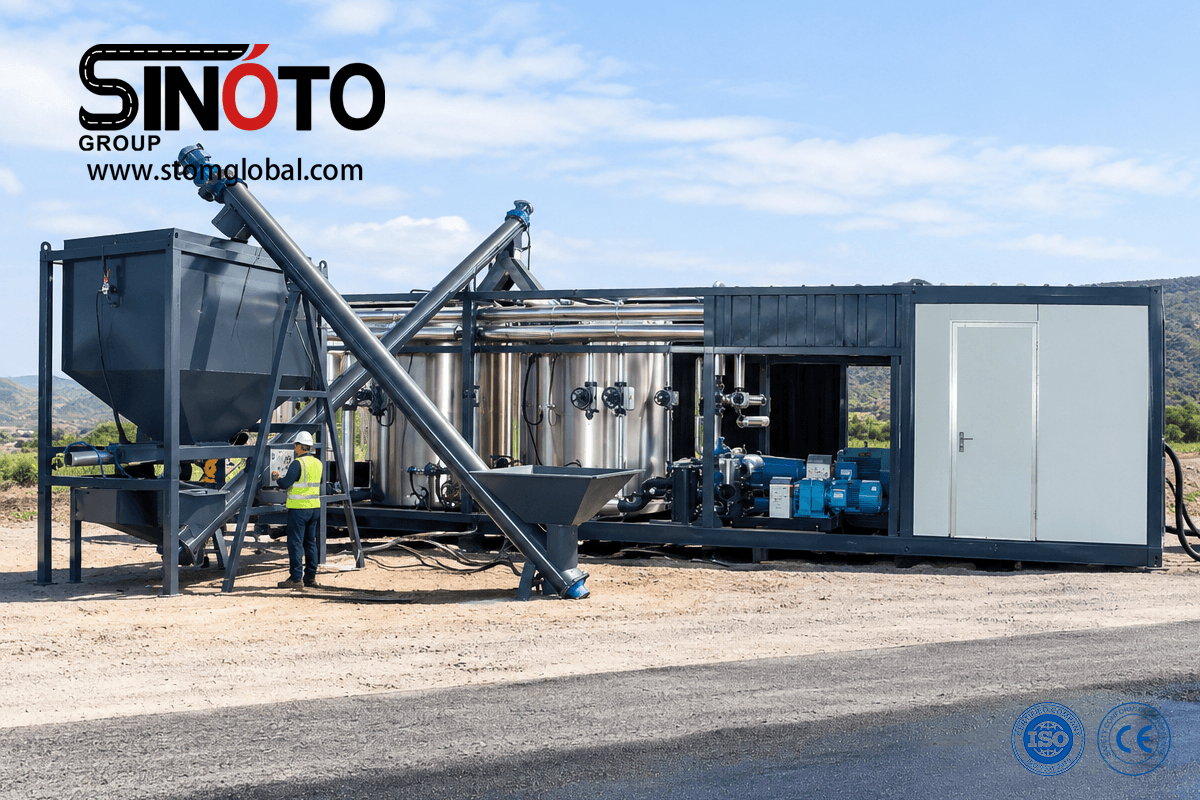
Contractors and traders who evaluate an 8-80t/H Polymer Modified Bitumen Modification Plant raise the same concerns:
💬 Buyer tip: Ask every supplier for furnace rating (kcal/h), heat exchanger area (m²), thermal oil regulating method and insulation specification. These four numbers reveal more than a brochure.
SINOTO publishes clear furnace figures for its Modified Bitumen Plant with Polymer Rubber Mixing Tank and Asphalt Production series:
| Parameter | STMB-6 | STMB-10 | STMB-20 |
|---|---|---|---|
| Productive capacity | 5–6 t/h | 8–10 t/h | 15–20 t/h |
| Thermal oil furnace | 6×10⁵ kcal/h | 8×10⁵ kcal/h | 12×10⁵ kcal/h |
| Approx. kW equivalent | ~698 kW | ~930 kW | ~1,396 kW |
| Spiral-plate heat exchanger | – | 100 m² | 2×100 m² |
| Mixing tank | 7 m³ | 5 m³ | 6 m³ |
| Swelling tank | 7 m³ | 5 m³ | 6 m³ |
| Colloid mill | 45/75 kW | 75 kW | 2×75 kW |
| Total power | 65 kW | 100 kW | 200 kW |
| Furnace kcal/h per t/h (at top output) | ~100,000 | ~80,000 | ~60,000 |
Model data from the SINOTO product page. kW equivalents and per-t/h ratios are our calculations (1 kcal/h ≈ 1.163 W).
The ratio falls from roughly 100,000 to 60,000 kcal/h per t/h as the plant grows. Our reading is that this reflects the added spiral-plate heat exchangers on the STMB-10 and STMB-20. These allow continuous-flow heating, so the plant does not have to heat large static volumes. As a working guide, plants of this design need about 60,000–120,000 kcal/h of thermal oil capacity for each t/h of output.
For a buyer of a 10-25t/H Polymer Modified Bitumen Asphalt Plant for Road Construction, that range points to about 0.8–1.5 million kcal/h. The STMB-10 and STMB-20 sit inside it, and the 25 t/h end would call for a customized furnace or a dual-furnace layout. For 8-80t/H Polymer Modified Bitumen Modification Plant requirements above 20 t/h, treat the ratio as a starting estimate only and have the manufacturer validate it.
📌 Key Takeaway: For SINOTO’s reference models, the furnace rating is 6×10⁵ kcal/h for STMB-6, 8×10⁵ kcal/h for STMB-10 and 12×10⁵ kcal/h for STMB-20.
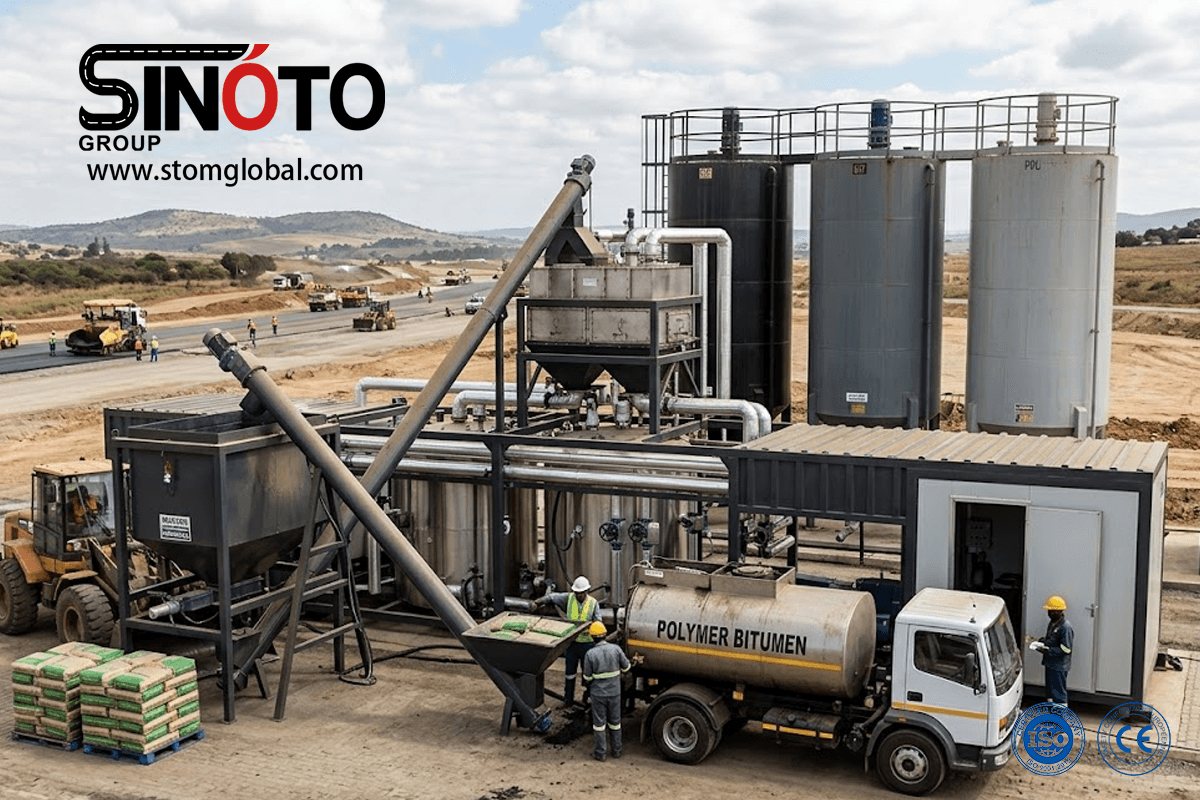
The rating is not the steady-state load. The basic equation is:
Q = m × c × ΔT + heat losses
where m is mass flow (kg/h), c is specific heat (about 0.5 kcal/kg·°C for bitumen) and ΔT is the temperature rise.
| Heat Demand | Estimate (kcal/h) |
|---|---|
| Base bitumen 130°C → 180°C (10,000 kg/h × 0.5 × 50) | ~250,000 |
| Polymer heating (~5% SBS dosed at ambient) | ~40,000 |
| Tank, pipe and heat exchanger losses (10–15%) | ~30,000–45,000 |
| Steady-state total | ~320,000–335,000 |
| Cold start of ~10 m³ tanks (30°C → 170°C in about 1 hour) | ~700,000 |
Assumptions: bitumen density about 1 t/m³, steel mass and ambient conditions ignored. Real values depend on climate, insulation and recipe.
The steady-state need is around 330,000 kcal/h. The 800,000 kcal/h furnace of the STMB-10 is about 2.4 times that. The extra capacity serves three purposes:
For a Sbs Bitumen Rubber Modified Bitumen Polymer Modified Bitumen Plant, high polymer content and crumb rubber increase viscosity. That raises the pumping and mixing load and tightens the temperature window, so lean toward the upper end of the capacity range.
When you evaluate an Automatic Bitumen Emulsion Asphalt Plant Manufactures Price or a PMB plant quote, look at how the heating system is controlled. SINOTO’s design includes the following.
🎛️ Intelligent thermal control. A PLC and industrial computer offer automatic and manual modes, so production can continue even if an instrument fails. Thermal oil is regulated by dual control through a dedicated regulating valve. Together with temperature sensors, it forms a PID loop that precisely governs bitumen temperature. The bitumen can heat up rapidly even when the furnace runs at low power.
⚙️ Continuous heating. The spiral-plate heat exchanger raises bitumen temperature quickly under airtight conditions, which limits aging. Production runs without batch intervals, and the equipment can operate 24 hours a day.
🔩 Durable core components. The wear-resistant colloid mill is rated for 100,000 tons of trouble-free operation. Dual mills can run in series or in parallel. Fineness stays above 85% under 10 microns.
🧪 Flexible recipes. The plant handles SBS, SBR, SIS, PE, EVA and rubber powder, and is compatible with polymer brands such as Kraton, Dynasol and LG Chem. Preset software parameters switch quickly between high-elasticity and high-viscosity asphalt. Static weighing of modifiers gives higher accuracy than dynamic weighing.
📦 Modular, mobile-friendly design. The integrated skid design ships in standard containers and starts production once pipelines and power are connected. That makes it suitable as Polymer Modified and Emulsified Asphalt Equipment Modified Mobile Bitumen Plant for contractors who move between sites, and it pairs well with an emulsion plant for polymer-modified emulsions.
💬 Why it matters: A Polymer Modified Bitumen Asphalt Plant for Road Construction is judged by the consistency of its product batch after batch. Precise heating is what delivers it.
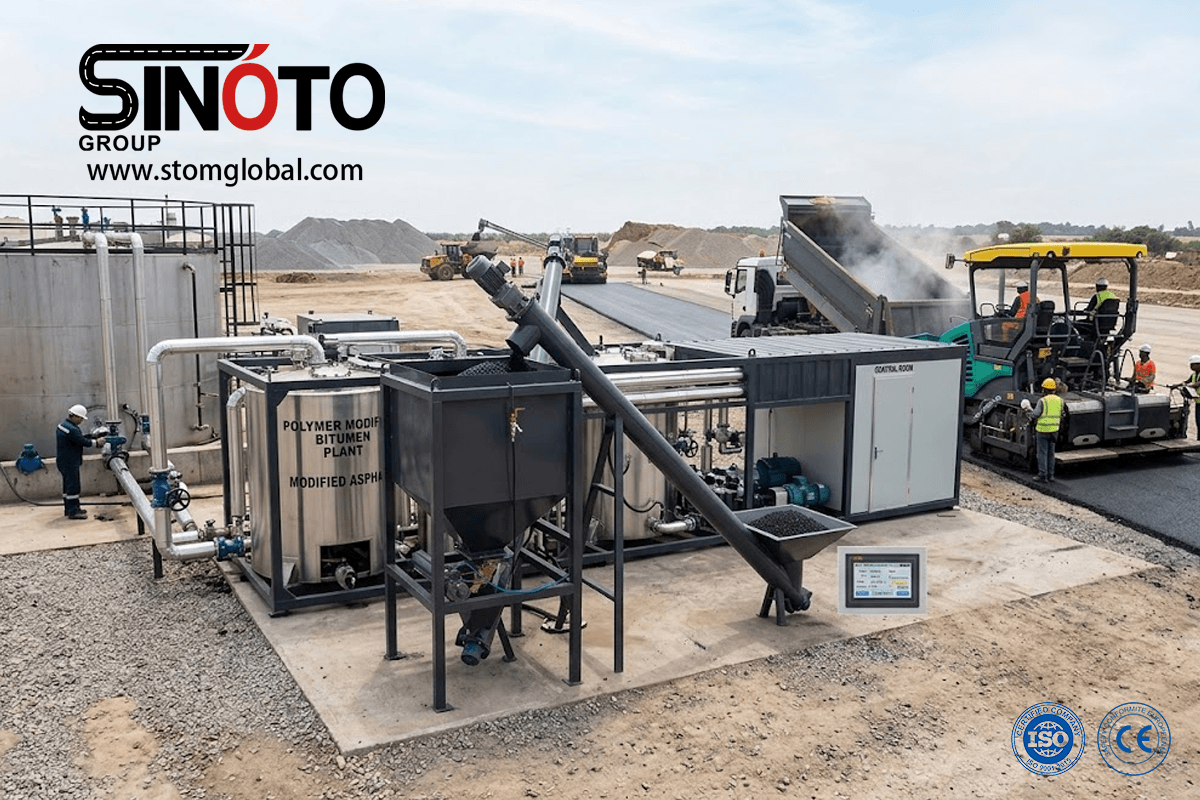
Send your target output, polymer type and site conditions, and SINOTO’s engineers will propose the right furnace rating and plant configuration for your project.
👉 Request a Free Quote and Technical Consultation Now
📧 info@stomglobal.com | 📱 WhatsApp: +86 190 5958 1045
#PolymerModifiedBitumenPlant #PMBPlant #SBSModifiedBitumen #ThermalOilHeater #RoadConstruction #AsphaltEquipment

Whatsapp ID: 8619059581045

WeChat ID: +8619059581045

