If you are sourcing a polymer modified bitumen plant for highway paving, waterproofing membranes or a regional bitumen terminal, two questions come before everything else. First, how many tons per hour (TPH) can the equipment really deliver? Second, is it a batch process or a fully continuous inline process? The answers set your delivery schedule, your labor cost and the consistency of every load of modified binder that leaves your site.
This guide uses the published specifications of the SINOTO STMB series to answer both questions. It also explains what experienced buyers check before they ask for a PMB plant price.
| Key Fact | Data | |
|---|---|---|
| ⚙️ | Production capacity | 5–20 TPH (three models) |
| 🔬 | Polymer fineness | More than 85% of particles below 10 microns |
| 🔄 | Process type | Continuous, 24-hour operation |
| 🧪 | Compatible modifiers | SBS, SIS, SBR, PE, EVA, rubber powder |
| 📦 | Design | Modular, container-shippable |
| 🛡️ | Colloid mill life | Rated for 100,000 tons of trouble-free operation |
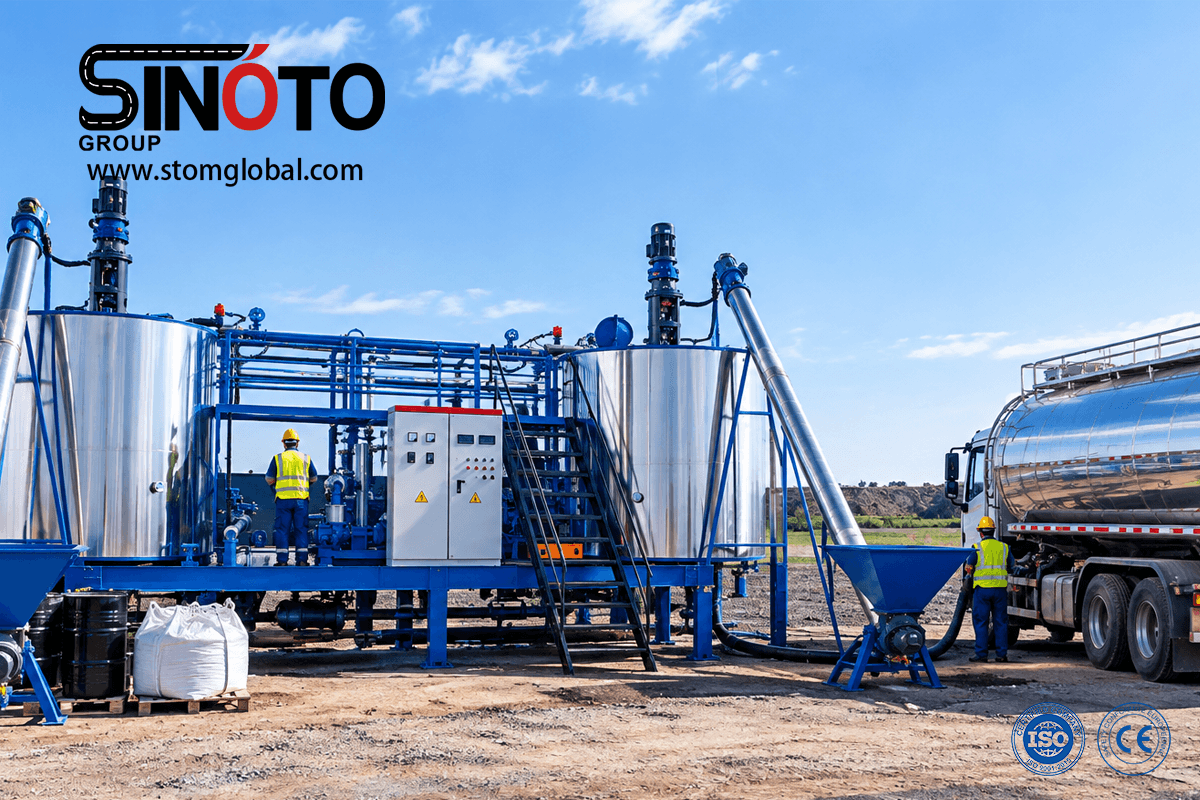
The SINOTO SBS modified bitumen plant range covers 5 to 20 tons per hour across three standard models. This is finished modified bitumen output, not the flow rate of the base bitumen pump. It is the figure to use when you plan tonnage per shift.
Capacity does not come from one component. It comes from sub-systems that are matched to each other:
If any one of these is undersized, the nameplate figure will not hold under real load.
Real output also depends on your formulation. A high SBS content, a high target viscosity or a crumb rubber addition needs more shear and more swelling time, so your effective TPH may sit toward the lower end of a model’s range. Give the supplier your base bitumen grade and target polymer dosage before you fix the model.
💡 Buyer tip: Ask every supplier to state capacity at your polymer dosage and your fineness target. A TPH figure with no formulation attached is a marketing number, not an engineering number.
According to the manufacturer, this line is designed for continuous production throughout the process, with no batch interval operations, and it can run for 24 hours. The key is the spiral-plate heat exchanger. It raises the bitumen temperature quickly in a sealed flow, which limits aging, so material does not sit in a heating tank waiting for a batch to complete.
🛢️ Base bitumen → 🔥 Rapid heating → ⚖️ Metering and SBS dosing → 🌀 Colloid mill shearing → ⏳ Swelling and development → 🏭 Maturation and storage
Each stage feeds the next in a steady stream:
Continuous does not mean instant. SBS needs residence time to develop, which is why swelling tanks of 5–7 m³ remain part of the line. What changes is that these stages are fed by a steady stream rather than filled, processed and emptied in cycles.
| Factor | Traditional Batch Modified Bitumen Plant | Continuous Inline PMB Plant (STMB Series) |
|---|---|---|
| Workflow | Fill, heat, mix, discharge, repeat | Steady flow from heating to storage |
| Downtime between loads | Regular gaps between batches | No batch interval operations |
| Output stability | Can vary from batch to batch | Consistent, controlled by PLC |
| Operator involvement | High | Lower, with automatic dosing and PID temperature control |
| Typical run mode | Shift-based | Up to 24 hours continuously |
Control is the other half of consistency. The system uses a PLC and an industrial computer, with automatic and manual modes, and production can continue even if an instrument fails. A PID loop links the PLC, the temperature sensors and a dedicated thermal oil regulating valve to raise and lower bitumen temperature precisely. Software presets let operators switch quickly between, for example, high-elasticity and high-viscosity products.
One detail to check when you compare models is that the STMB-6 is offered with manual control, while the STMB-10 and STMB-20 offer manual or automatic control. If you want automatic dosing, specify the STMB-10 or larger.
📌 Bottom line: If uninterrupted output and repeatable quality matter to you, a continuous SBS bitumen plant is the better fit. The batch interval, and the variation that comes with it, is what the inline design removes.
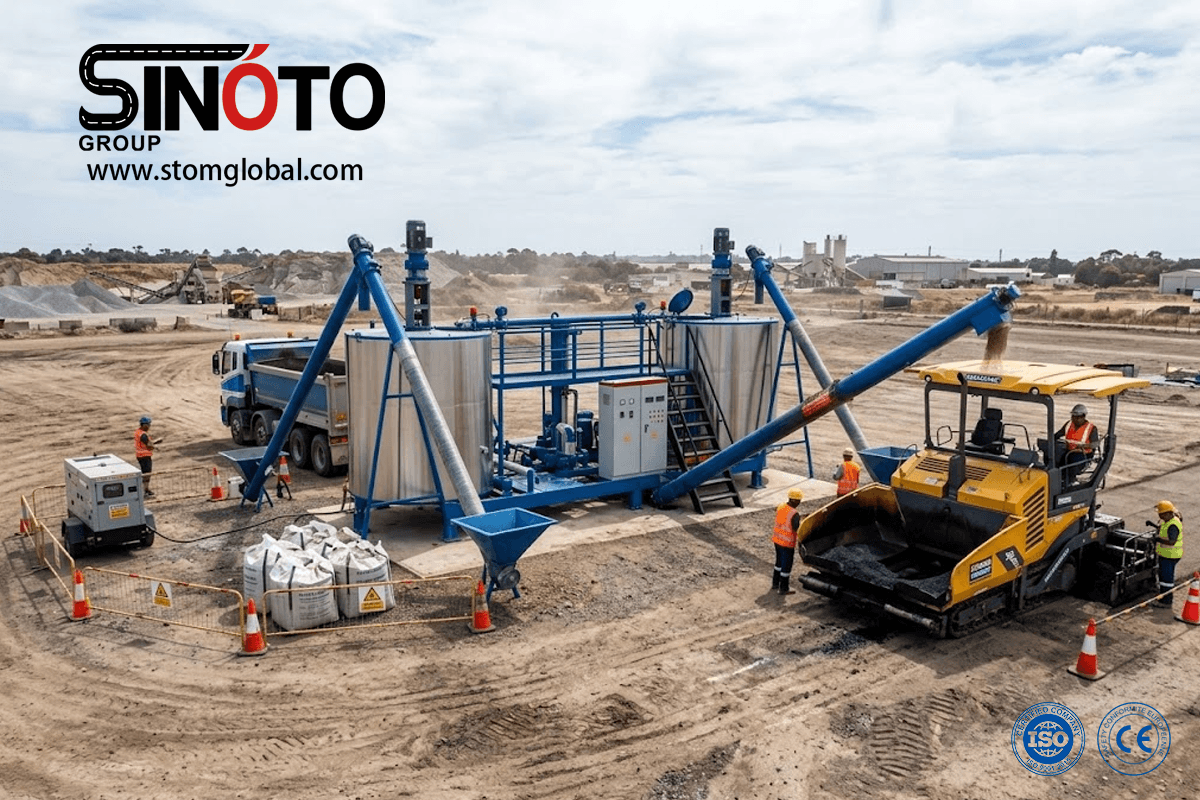
Here is how the three STMB models compare, using the manufacturer’s technical parameters:
| Item | STMB-6 | STMB-10 | STMB-20 |
|---|---|---|---|
| ⚙️ Capacity | 5–6 t/h | 8–10 t/h | 15–20 t/h |
| 🌀 Colloid mill | 45 kW / 75 kW | 75 kW | 2 × 75 kW |
| 🛢️ Mixing tank | 7 m³ | 5 m³ | 6 m³ |
| ⏳ Swelling tank | 7 m³ | 5 m³ | 6 m³ |
| 🔥 Spiral-plate heat exchanger | – | 100 m² | 2 × 100 m² |
| ⚖️ SBS adding system | 2 × 2 tph | 2 × 3 tph | 2 × 4 tph |
| 🔧 Base bitumen pump | 5.5 kW | 7.5 kW | 15 kW |
| 🖥️ Control system | Manual | Manual / Automatic | Manual / Automatic |
| 🔥 Thermal oil furnace | 6×10⁵ kcal | 8×10⁵ kcal | 12×10⁵ kcal |
| ⚡ Total power | 65 kW | 100 kW | 200 kW |
| 📦 Total weight | 6.5 t | 10 t | 25 t |
Choose the STMB-6 if you supply a single paving crew or a small maintenance program, want the lowest power demand (65 kW), and are comfortable with manual control.
Choose the 10 TPH PMB plant (STMB-10) if you run several projects a season and want automatic control. It is the most balanced SBS modified bitumen plant in the range, and one 100 m² heat exchanger keeps heating efficient.
Choose the 20 TPH polymer modified bitumen plant (STMB-20) if you supply a large highway program or sell modified binder commercially. It has two colloid mills, which the manufacturer says can run in series or in parallel, and the largest heating capacity in the range. Plan for 200 kW of power and a 25-ton footprint.
A simple sizing check is to divide your peak daily modified bitumen demand by your realistic operating hours. Then add a margin for the polymer dosage and viscosity you actually run, since heavy modification can push effective output toward the lower end of the range.
Buyers who compare a PMB plant for sale on price alone often discover the real differences later, in fineness, downtime and maintenance cost. Before you request a polymer modified bitumen plant price, confirm these points:
What drives the PMB plant price is mainly the model (capacity), the number of colloid mills, the control level (manual or PLC automatic), the heat exchanger and furnace size, and optional storage or accessories. These items differ between the STMB-6, STMB-10 and STMB-20, which is why a single fixed figure is rarely useful. A reliable SBS bitumen plant manufacturer should give you a written configuration and quotation against your own tonnage and formulation.
🧾 Procurement note: Compare quotes line by line: mill power, heat exchanger area, furnace rating, control system and included spare parts. A lower headline price often reflects a smaller mill or a manual control system.
A modified bitumen plant is a precision process line rather than a simple mixing tank, so the manufacturer’s engineering counts. Here are the selling points the SINOTO STMB series brings to buyers:
SINOTO is Henan Sinoto Machinery Technology Co., Ltd. of Zhengzhou, China. It supplies asphalt machinery and road construction equipment to contractors worldwide, and its range also covers bitumen melting machines, emulsion plants and asphalt mixing plants. This lets you match a PMB plant to an upstream or downstream line from a single supplier.
The advice is the same whether you choose an SBS modified bitumen plant manufacturer in China or elsewhere. Ask for the technical parameters, the process flow and a reference project before you decide.
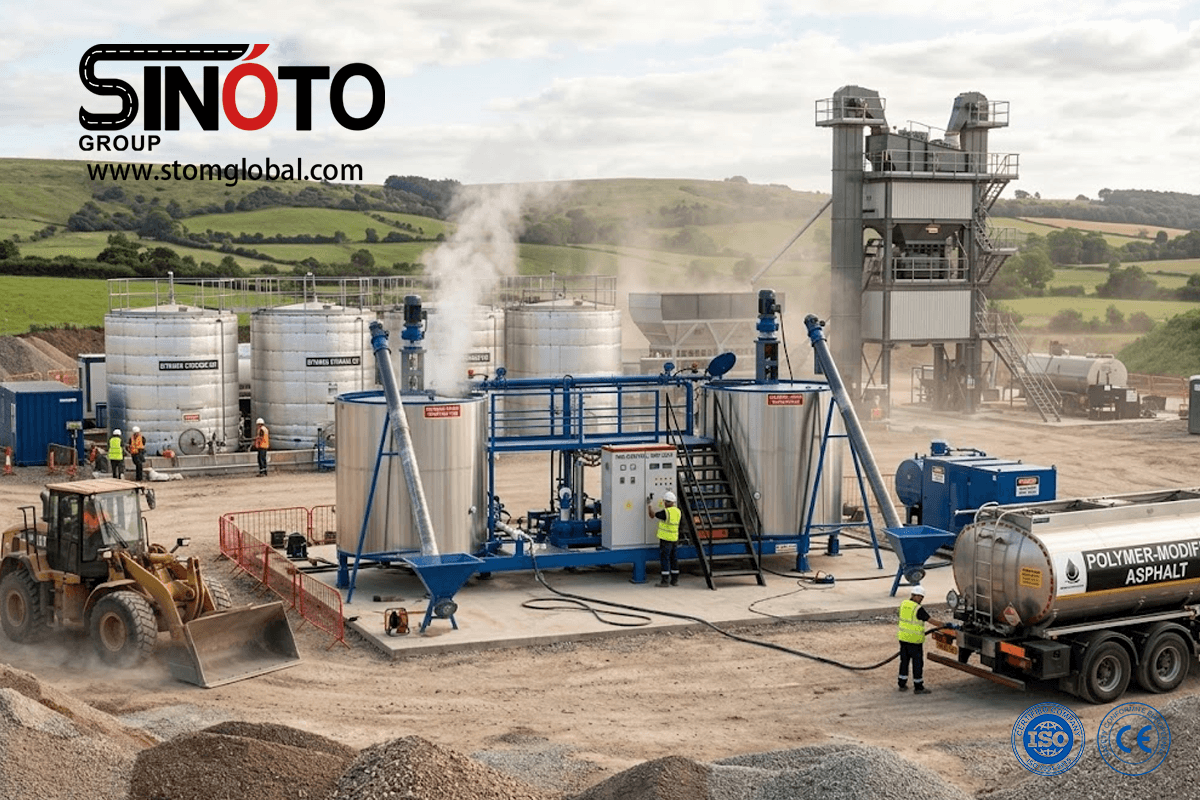
Tell us your target TPH, polymer type and project location, and our engineers will recommend the right STMB model with a detailed configuration and PMB plant price.
📧 info@stomglobal.com | 📱 WhatsApp: +86 190 5958 1045
#PMBPlant #PolymerModifiedBitumen #SBSModifiedBitumen #BitumenEquipment #RoadConstruction

Whatsapp ID: 8619059581045

WeChat ID: +8619059581045

