Buyers comparing modified bitumen equipment tend to ask the same two questions before they discuss price: how fine will the polymer be after milling, and will the finished binder stay uniform in the tank for days? Both questions decide whether your roads crack early or your waterproofing membranes separate on site. This guide explains, in plain engineering terms, what a modern modified bitumen plant can promise on particle size and how the process protects dispersion and storage stability. The specifications discussed come from the STMB series of polymer modified bitumen plant models offered by SINOTO (STOM Global).

First, a small clarification. The particles being reduced in a PMB line are mostly the polymer, not the base bitumen. Bitumen is liquid at processing temperature; SBS, SIS, PE or EVA arrives as solid granules or powder. The colloid mill shears those solids into micron-scale droplets that can be absorbed and swollen by the maltene fraction of the bitumen.
For this product line, the stated guarantee is a fineness of more than 85% of particles below 10 microns after the material passes through the mill. This applies to all three models, STMB-6, STMB-10 and STMB-20, and to every modifier type the plant handles. Note the wording: it is a distribution figure, not an absolute ceiling. In a real SBS modified bitumen plant, a small share of particles will always sit above 10 microns, which is why the figure is expressed as a percentage.
Buyer tip: ask any supplier of a PMB plant for sale how fineness is measured (fluorescence microscopy, laser diffraction or sieve residue), on which polymer grade, and at what dosage. A number without a test method is only a marketing claim.
Why does 10 microns matter? Under Stokes’ law, the speed at which a particle rises or settles in a fluid grows with the square of its diameter. Halving the particle size therefore cuts the separation tendency to roughly a quarter. A binder in which most polymer particles are under 10 microns behaves much more like a stable colloid than a coarse blend, which is the foundation of both dispersion quality and storage stability.
| Item | STMB-6 | STMB-10 | STMB-20 |
|---|---|---|---|
| Productive capacity | 5–6 t/h | 8–10 t/h | 15–20 t/h |
| Colloid mill | 45 kW / 75 kW | 75 kW | 2 × 75 kW |
| Fineness | More than 85% below 10 microns | ||
| Modifier types | SBS, SIS, PE, EVA and others | ||
| Mixing / swelling tank | 7 m³ / 7 m³ | 5 m³ / 5 m³ | 6 m³ / 6 m³ |
| SBS adding system | 2 × 2 tph | 2 × 3 tph | 2 × 4 tph |
| Control system | Manual | Manual / Automatic | Manual / Automatic |
| Total power | 65 kW | 100 kW | 200 kW |
Two design details help the plant hold that fineness over years rather than weeks. The mill body uses highly wear-resistant material, and the manufacturer targets 100,000 tons of trouble-free operation, so the rotor-stator gap does not open up and let coarse particles through. On the STMB-20, dual colloid mills can run in series for finer grinding or in parallel for throughput, letting a single modified bitumen production plant adapt to tougher formulations.
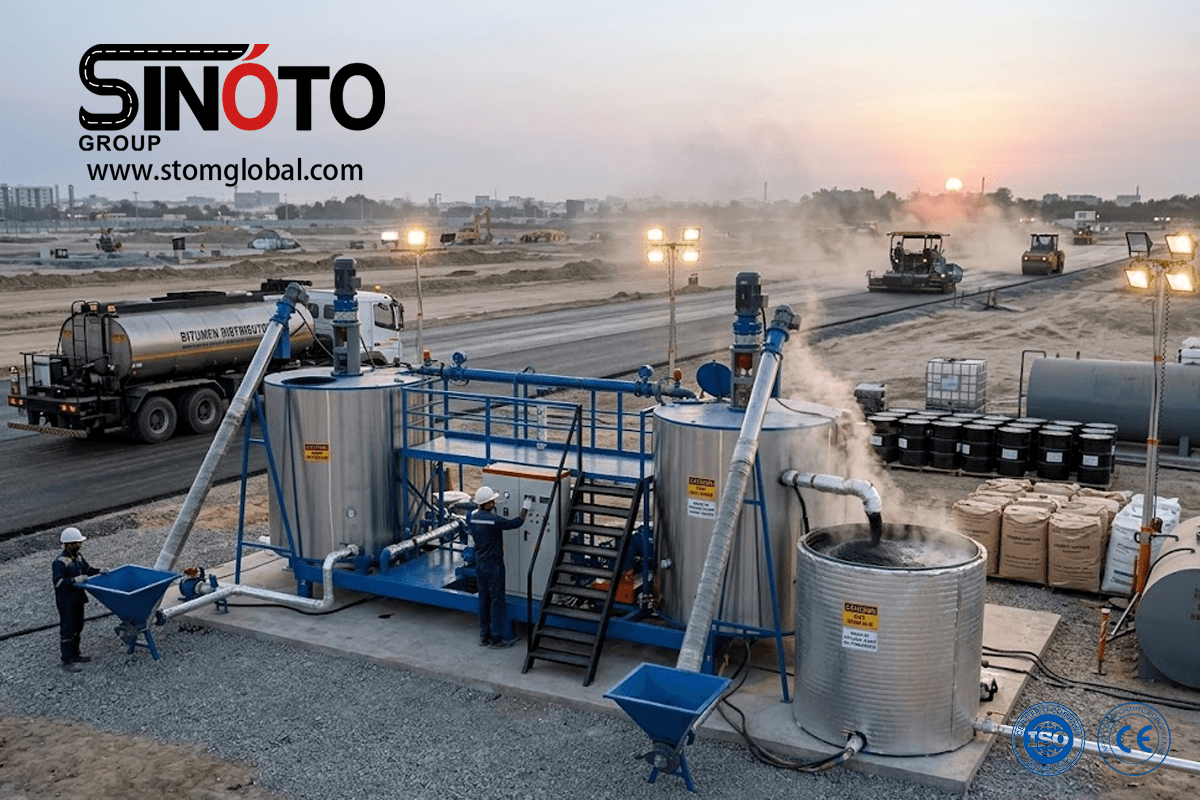
Dispersion is not a single step. It is the result of a chain: accurate dosing, rapid mixing, high shear, controlled swelling and stable temperature. If any link is weak, the finished PMB will show polymer lumps, uneven elasticity or a gritty texture on the spread test. A well-designed polymer modified asphalt plant therefore treats the process as a system.
The STMB plants use a base asphalt metering system and a screw feeding system for the modifier. The modifier is measured by static weighing, which the manufacturer notes is more accurate than dynamic weighing. On automatic models, a PLC-controlled dosing system weighs additives and stabilizers consistently, reducing human error and keeping polymer content within specification batch after batch.
The base bitumen is heated quickly through a spiral-plate heat exchanger (100 m² on the STMB-10, two units on the STMB-20). Heating under air-sealed conditions limits oxidation, so the base binder does not age before it meets the polymer. Thermal oil is regulated through a dedicated control valve, and a PID loop built from the PLC, temperature sensors and that valve raises or lowers bitumen temperature precisely, even when the thermal oil furnace runs at low power.
Once the polymer is pre-mixed by high-speed stirring, the slurry passes through the high-torque colloid mill. Reinforced agitators and a strong mill drive allow the system to process high-content SBS and even rubber crumb, which are the formulations that overload lighter equipment. This is the step that produces the sub-10-micron distribution described above.
Milling alone does not create a stable modified binder. The fine polymer must absorb light fractions from the bitumen and swell into a continuous network. Dedicated swelling (development) tanks with thermal oil heating and specialised paddles give the polymer time to react fully. Skipping or shortening this stage is one of the most common reasons low-cost PMB plant offers deliver binders that fail the segregation test.
| Process stage | Main control | Effect on dispersion |
|---|---|---|
| Dosing | Static weighing, PLC | Correct polymer ratio, no lumps from overdosing |
| Heating | Spiral-plate exchanger, PID | Fast, uniform temperature without aging |
| Pre-mixing | High-speed stirring | Polymer wetted before milling |
| Milling | Colloid mill, 1 or 2 units | >85% of particles below 10 µm |
| Swelling | Development tank, paddles | Full polymer–maltene interaction |
Storage stability describes whether the polymer stays evenly distributed while the binder waits in a tank at elevated temperature. Poor stability shows up as a polymer-rich layer floating on top and a polymer-poor layer below, which leads to inconsistent paving mixes and rejected loads. Industry practice typically checks this with a segregation test, where the softening-point difference between the top and bottom of a heated tube after 48 hours must remain small. Many tender specifications set that limit at about 2.5 °C, but always confirm the figure in your own specification.
An SBS bitumen plant influences that result in four ways.
Fine, narrow particle distribution. As explained above, smaller particles separate more slowly. This is the single strongest lever, and it comes directly from the mill.
Complete swelling before storage. A polymer that has fully developed is physically bound into the bitumen matrix, so it resists creaming. The maturation and storage system on the STMB plants is designed to finish this reaction before the binder is discharged.
Stabilizer dosing. The main components of each model include a stabilizer dosing system. Stabilizers, commonly sulfur-based compounds, help create cross-links between polymer and bitumen, which makes the network more resistant to separation and thermal degradation during storage and transport.
Stable temperature and low degradation. Thermal oil heating avoids local hot spots that could break down SBS chains. Pipelines for both bitumen and heat transfer oil are wrapped in rock wool, so temperature does not swing between production and storage.
Engineering insight: storage stability is a shared result of grinding, swelling and cross-linking. A plant that only advertises a powerful mill, without a proper development tank and stabilizer dosing, addresses one third of the problem.
Consistency also depends on continuity. Because the spiral-plate heat exchanger keeps the flow moving, the line runs without batch intervals and can operate for 24 hours. Continuous production keeps every tonne of PMB on the same heat and shear history, which is what makes properties repeatable between shifts. The intelligent control system supports this with automatic and manual modes, and production can continue even if an instrument fails. Preset software parameters let operators switch between high-elasticity and high-viscosity binder modes without reworking the line.

Whether you are shopping for modified bitumen equipment for a highway contractor, a waterproofing membrane factory or a regional bitumen terminal, use the following checklist to compare offers on equal terms.
| Buyer concern | What to ask | What this plant offers |
|---|---|---|
| Particle size proof | Test method, polymer grade, report | >85% below 10 µm across all models |
| Polymer compatibility | Which brands and modifiers are supported? | SBS, SIS, PE, EVA; works with Kraton, Dynasol and LG Chem grades |
| Wear life | Mill material and service target | Wear-resistant mill, 100,000 t target |
| Dosing accuracy | Static or dynamic weighing? | Static weighing, PLC dosing |
| Site flexibility | Transport and start-up time | Modular, container-friendly, connect pipes and power |
| Application range | Roads, waterproofing, rubber blends | Surface, base and sub-base layers; roofs and basements |
Three further points deserve attention. First, capacity fit: choose the STMB-6 for small projects and pilot production, the STMB-10 for regional contractors needing automatic control, and the STMB-20 for high-volume supply. Second, mobility: the modular, skid-style design is easy to relocate, which suits international contractors moving between project sites. Third, support: ask about commissioning, operator training and spare parts, because even the best modified asphalt plant depends on correct operation.
The guaranteed fineness of more than 85% below 10 microns gives the SBS modified bitumen plant a clear, measurable starting point, and the surrounding process turns that fineness into lasting dispersion and storage stability. Accurate static dosing, fast air-sealed heating, a wear-resistant colloid mill, dedicated swelling tanks and stabilizer dosing work together, while PID temperature control and 24-hour continuous operation keep every batch consistent. If you are evaluating a polymer modified bitumen plant for road construction or waterproofing, request a fineness test report and a segregation test result, then compare them against your project specification.
Get a tailored configuration, capacity recommendation and quotation from the SINOTO engineering team.
Request a Free Quote →Or email info@stomglobal.com | WhatsApp +86 190 5958 1045

Whatsapp ID: 8619059581045

WeChat ID: +8619059581045

