When contractors compare a Polymer Modified Emulsion Asphalt Plant Production Line for Polymer Modified Bitumen, the first question is often about tank volume or motor power. Experienced buyers ask something else: who is really running the process, the operator or the control system? Polymer modification is unforgiving. If the temperature drifts by a few degrees, if the SBS dosing is off by a few kilograms, or if shearing time varies from batch to batch, the result is segregation, poor elastic recovery and a road surface that fails early.
This article looks at the control architecture of the SINOTO STMB series from Henan Sinoto Machinery Technology Co., Ltd. It covers what is confirmed, what buyers should verify, and how to compare offers.

| Control Layer | What It Manages | Buyer Benefit |
|---|---|---|
| PLC + industrial computer | Sequencing, interlocks, auto/manual modes | Repeatable batches |
| PID temperature loop | Thermal oil valve, sensors, heat exchanger | Stable bitumen temperature |
| Static weighing system | Modifier dosing accuracy | Consistent polymer content |
| Frequency-converted pump | Bitumen flow rate | Precise ratio control |
| Preset software parameters | Product mode switching | Fast changeover between grades |
Yes, the system is PLC-based. According to the manufacturer’s product page, the control system of the Sbs Polymer Modified Bitumen Production Equipment Modified Asphalt Plant combines a PLC with an industrial computer and offers both automatic and manual operating modes.
That combination matters for three reasons.
1. The PLC handles the real-time work. Programmable logic controllers are built for harsh industrial sites. They manage motor start-up sequences, interlocks, pump speed, valve positions and alarms, and they keep running despite dust, vibration and temperature swings. That is exactly the environment of a roadside Modified Asphalt Manufacturing Plant Industrial Modified Bitumen Plant.
2. The industrial computer provides the operator interface. Operators see process values, set parameters and start or stop production from the screen, so they don’t have to walk between panels and manual valves.
3. Manual mode is a safety net. The manufacturer states that production can continue even if an instrument fails. Remote job sites are far from spare parts, so a plant that degrades gracefully to manual operation is worth a lot.
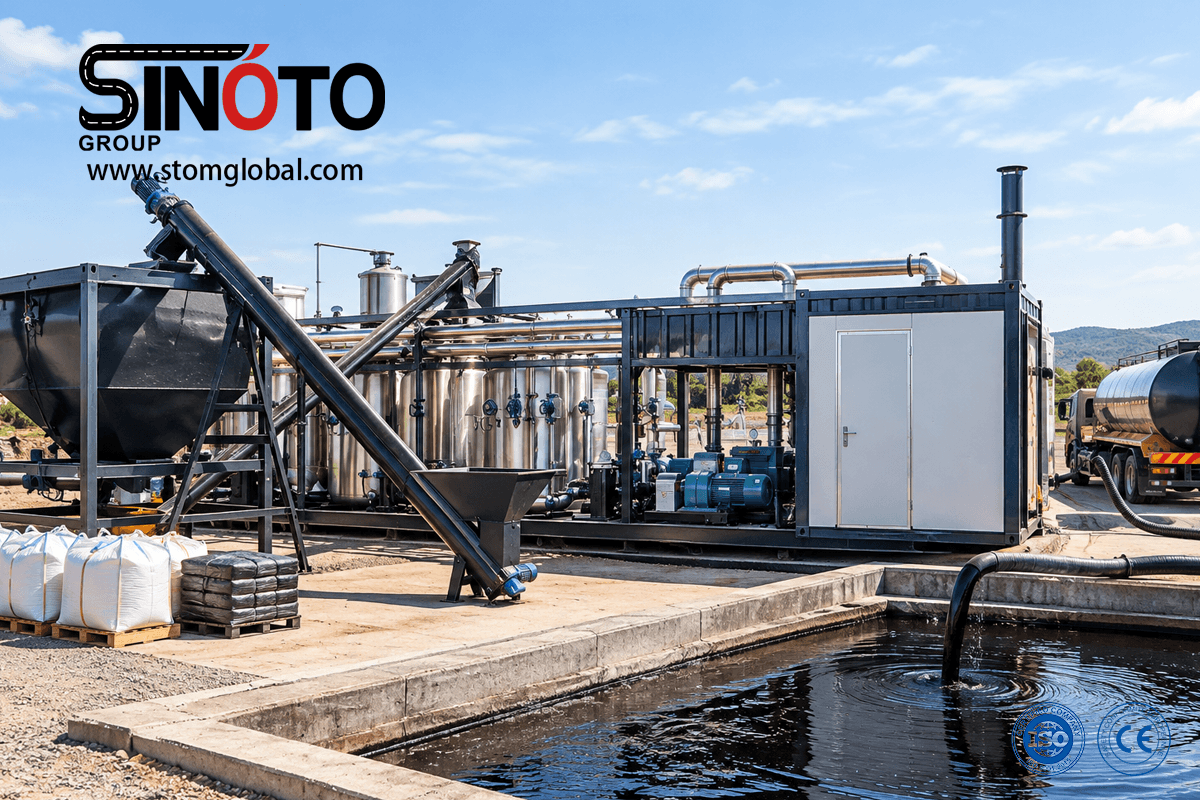
The temperature control is the strongest technical detail. The thermal oil regulating valve is a dedicated component, and together with the PLC and temperature sensors it forms a PID control loop. The bitumen temperature is regulated precisely as it rises and falls. Dual control of the thermal oil also lets the plant raise bitumen temperature quickly even when the thermal oil furnace runs at low power.
💬 Engineer’s Insight
“In polymer modification, temperature is the recipe. A plant that cannot hold its setpoint cannot reproduce its own results, no matter how good the colloid mill is.”
The asphalt pump is controlled by frequency conversion. This gives smooth flow adjustment, so the base bitumen and polymer ratio stays stable while output changes.
This is where buyers should read the specification carefully, because “recipe management” and “data logging” mean different things to different suppliers.
What the product page confirms:
Together these amount to functional recipe management: you define a product, and the plant reproduces it. Preset parameters keep operators from re-entering temperatures, dosing quantities and timing at every changeover.
What the page does not specify:
The page does not describe a SCADA package, remote monitoring over the internet, or detailed historical data logging with export. That doesn’t mean they are unavailable. But a responsible buyer should not assume they are included in the standard offer.
Before signing, ask the supplier to confirm in writing:
💬 Buyer’s Tip
If you sell modified bitumen to government road projects, ask for batch-level logs. Many tenders now require traceability of polymer content and production temperature, and a system that records these automatically can save you a dispute.
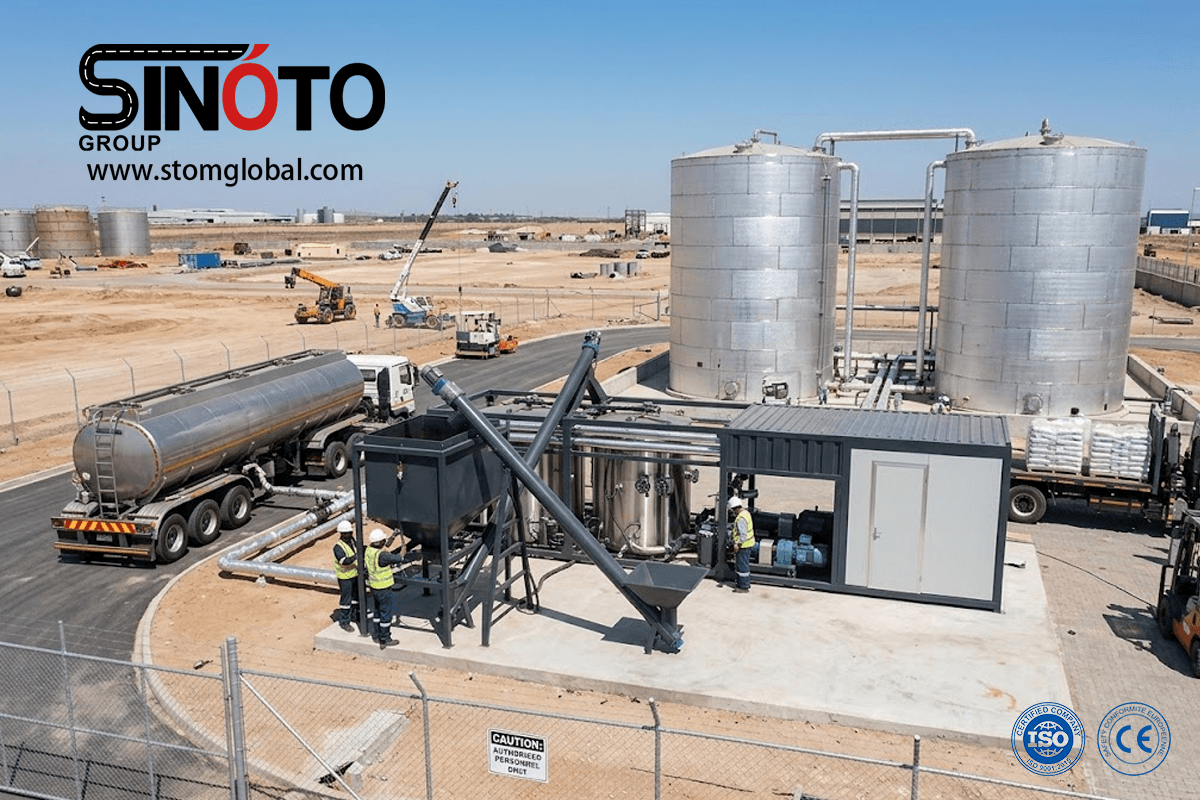
Procurement teams, whether contractors, distributors or asphalt producers, usually run through the same checklist. Below is how the STMB series answers each point, based on the manufacturer’s published information.
| Buyer Concern | What to Look For | STMB Series Information |
|---|---|---|
| Automation level | PLC, auto/manual modes | PLC + industrial computer; auto and manual |
| Dosing accuracy | Static vs dynamic weighing | Static weighing for modifiers |
| Temperature stability | PID loop, valve quality | PLC-based PID with dedicated thermal oil valve |
| Product flexibility | Multiple polymers, quick changeover | SBS/SIS/PE/EVA/SBR/rubber powder; preset parameters |
| Fineness | Colloid mill performance | >85% of particles below 10 microns |
| Durability | Wear-resistant mill | Rated for 100,000 tons of trouble-free operation |
| Continuous output | Heat exchanger design | Spiral plate heat exchanger; 24-hour operation |
| Logistics | Transportability | Modular design; container transport |
| Compatibility | Polymer brands | Kraton, Dynasol, LG Chem |
Two points deserve extra attention.
Automation depends on the model. The STMB-6 is listed with a manual control system, while the STMB-10 and STMB-20 offer manual/automatic control. Buyers who expect full PLC automation should choose the larger models or confirm the STMB-6 configuration in writing.
Fineness is a control issue as well as a mechanical one. A colloid mill produces fine particles, but only a stable process keeps them evenly distributed. When over 85% of particles are below 10 microns, the polymer disperses homogeneously and the storage stability of the finished binder improves. The dual colloid mills on larger models can run in series or in parallel, so operators can tune the shear intensity to the product.
The STMB-10 is the “sweet spot” of the range. As a 10tph Polymer Modified Emulsion Bitumen Production Plant for Pavement Road Asphalt feedstock supplier, it offers 8-10 t/h of output with a 75 kW colloid mill, a 5 m³ mixing tank, a 5 m³ swelling tank and a 100 m² spiral plate heat exchanger. It also offers the choice between manual and automatic control.
A note on terminology: an emulsion plant and a PMB plant are different machines. The PMB plant produces the polymer modified binder. An emulsion plant then disperses bitumen into water with emulsifiers. Many producers make PMB first and use it as the base for polymer modified emulsions, which is why buyers often search for both together. SINOTO supplies both, so a coordinated line is possible.
Why does the 10 t/h class fit so many customers?
The Polymer Modified Asphalt Bitumen Melting Machine Plant concept also fits here. Contractors who buy bitumen in drums or jumbo bags can pair the PMB plant with SINOTO’s barrel and jumbo bag melting machines, so that bulk base bitumen isn’t required.
Urban projects have particular demands: tight schedules, restricted work windows and strict quality inspection. A Sbs Modified Asphalt Plant Bitumen Modification Plant for Urban Road Construction must be predictable and easy to relocate. Here is how the three STMB models compare.
| Parameter | STMB-6 | STMB-10 | STMB-20 |
|---|---|---|---|
| Capacity | 5-6 t/h | 8-10 t/h | 15-20 t/h |
| Colloid mill | 45 kW / 75 kW | 75 kW | 2 × 75 kW |
| Mixing tank | 7 m³ | 5 m³ | 6 m³ |
| Swelling tank | 7 m³ | 5 m³ | 6 m³ |
| Heat exchanger | / | 100 m² | 2 × 100 m² |
| SBS adding system | 2 × 2 tph | 2 × 3 tph | 2 × 4 tph |
| Thermal oil furnace | 6×10⁵ kcal | 8×10⁵ kcal | 12×10⁵ kcal |
| Control system | Manual | Manual/Automatic | Manual/Automatic |
| Total power | 65 kW | 100 kW | 200 kW |
| Total weight | 6.5 t | 10 t | 25 t |
Quick selection guide:
Buyers who also want SCADA-style supervision should tell the supplier at the quotation stage. Retrofitting a control architecture after delivery is usually costlier than specifying it at the beginning.
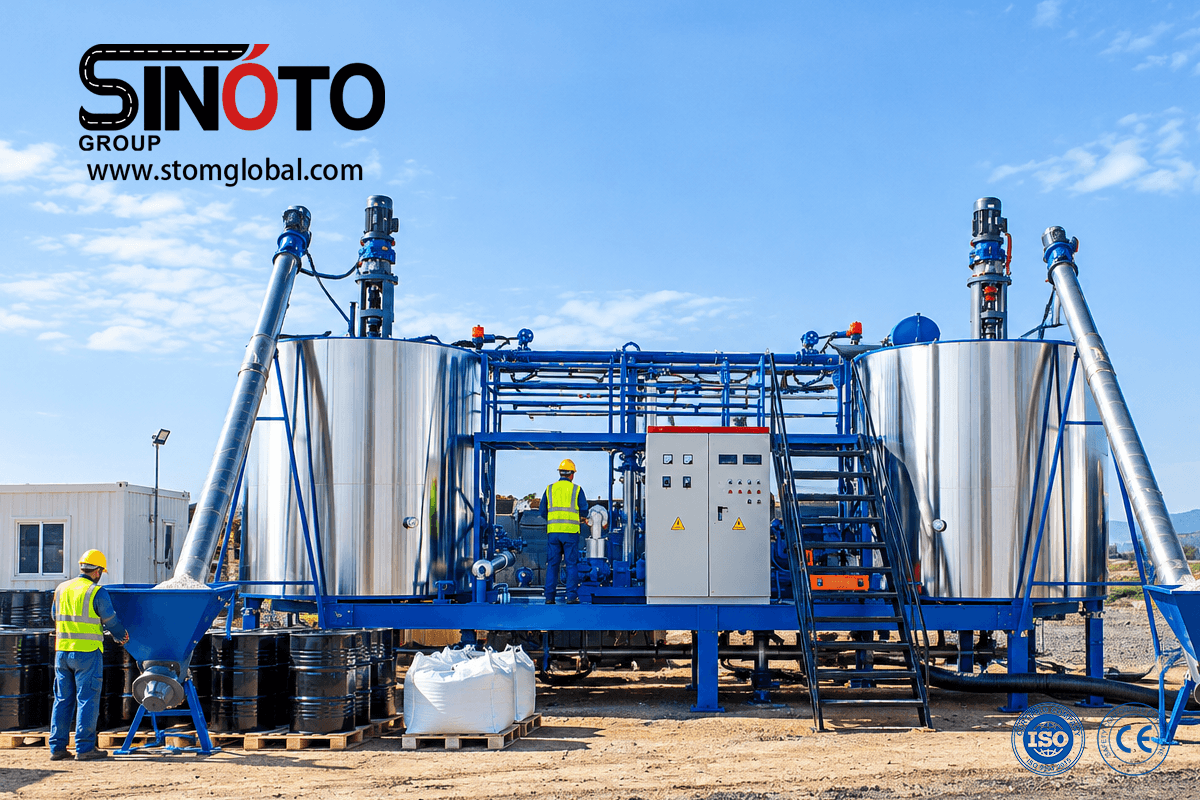
The control system of the SINOTO STMB series is PLC-based, paired with an industrial computer, and offers automatic and manual modes, PID temperature control, static weighing and preset parameters for fast product changeover. These features cover the core of recipe-style operation and repeatable production. For full SCADA supervision, remote monitoring and exportable data logging, the published information is not explicit, so the sensible step is to request written confirmation and a configuration list before ordering.
A Polymer Modified Asphalt Bitumen Emulsion Machine Plant, whether new or upgraded, is only as good as the control behind it. If you compare several suppliers of a New Polymer Modified Asphalt Bitumen Emulsion Machine Plant, ask each of them the same five control questions listed above. The answers will show quickly who has real automation and who has only a nice screen.
Tell the engineering team your target capacity, polymer type and automation requirements (including any SCADA, data logging or remote monitoring needs), and receive a tailored configuration and quotation.
👉 Request a Free Quote & Technical Consultation Now
📧 info@stomglobal.com | 📱 WhatsApp: +86 190 5958 1045
#PolymerModifiedBitumen #SBSModifiedAsphalt #BitumenModificationPlant #RoadConstruction #AsphaltEquipment

Whatsapp ID: 8619059581045

WeChat ID: +8619059581045

