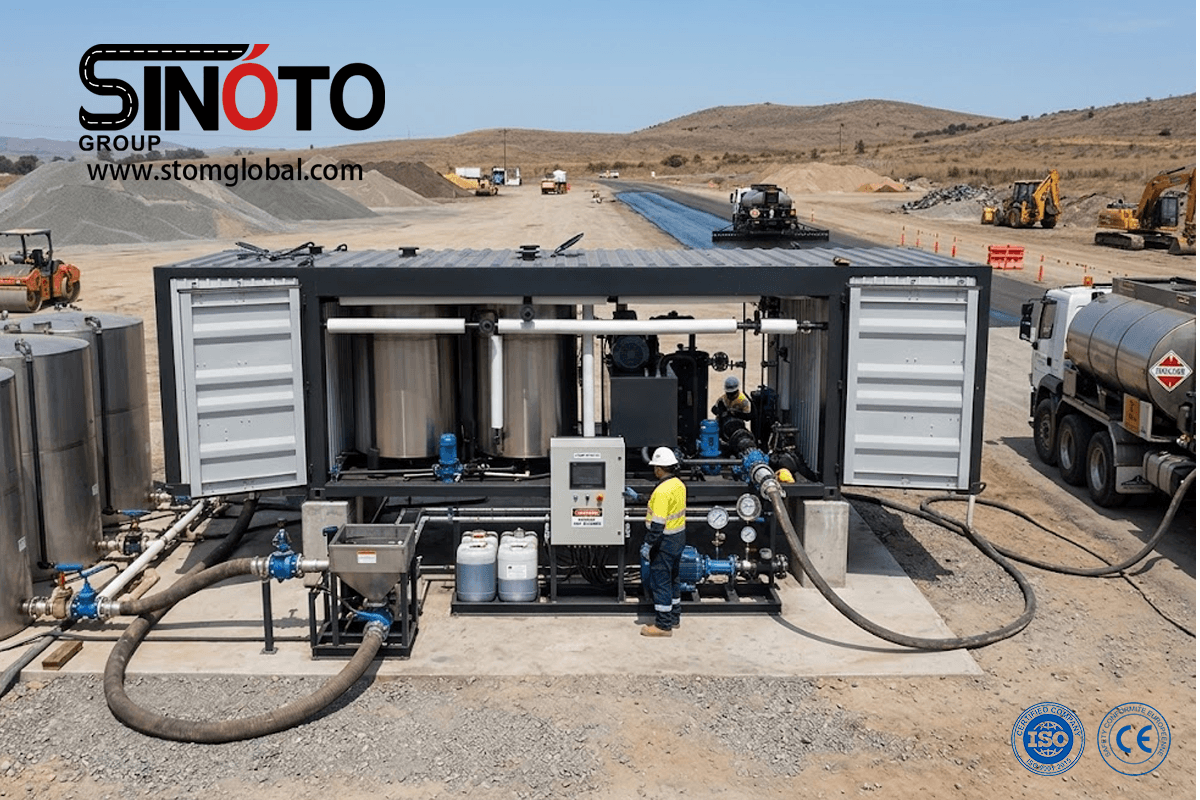
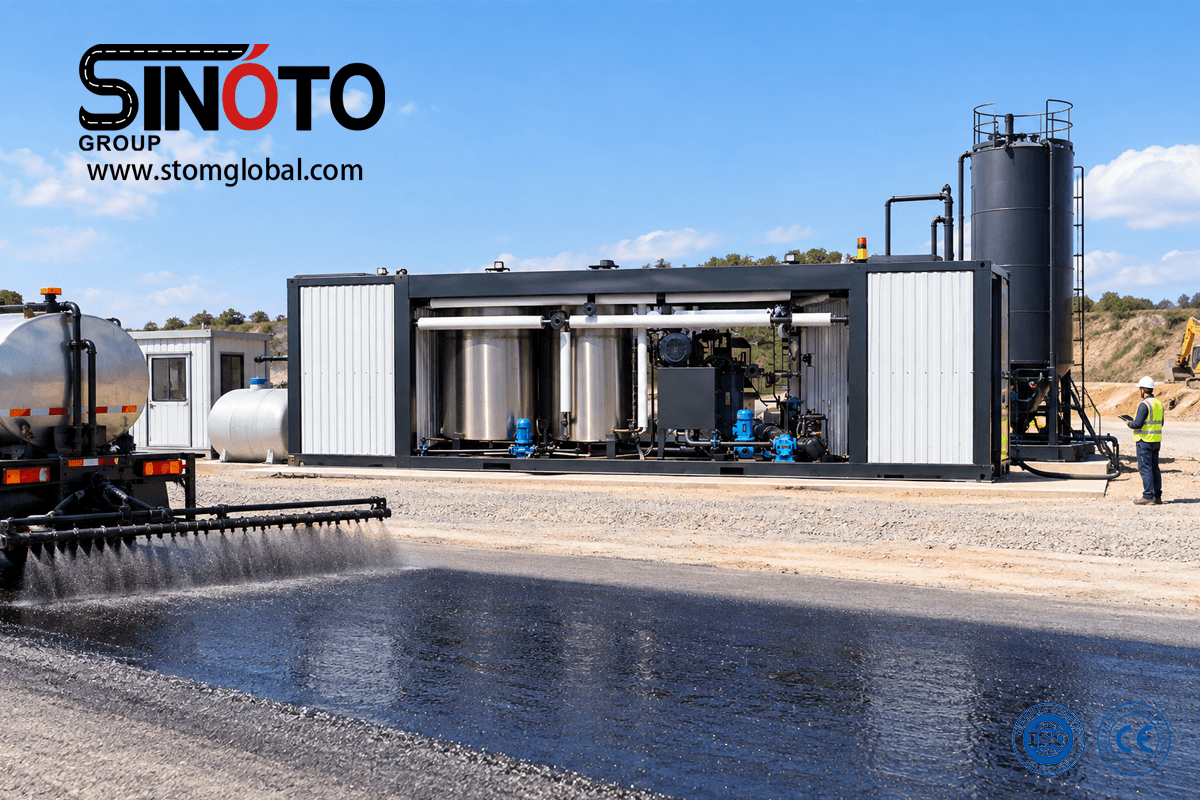
How is the soap solution prepared and metered in a bitumen emulsion plant? Are water, emulsifier, acid or alkali accurately proportioned? More importantly, can the asphalt and soap pumps work together automatically to maintain a stable bitumen-to-soap ratio?
These are important questions for contractors, asphalt producers, pavement maintenance companies, and distributors evaluating a bitumen emulsion plant for sale.
In an asphalt emulsion production line, the quality of the final emulsion depends heavily on accurate proportioning. Bitumen must be heated and metered into the emulsification system, while water and emulsifier are prepared as a controlled soap solution. Depending on the formulation, acid, alkali, or other additives may also be required.
The SINOTO bitumen emulsion plant uses Siemens PLC control technology for precise proportioning of asphalt, emulsion, and water. According to the manufacturer’s product information, the system includes automatic compensation with a stated proportioning error control within 0.5%. The asphalt and emulsion pipelines are controlled by pneumatic valves, reducing manual intervention. The two emulsion tanks operate alternately to support continuous production.
💡 Quick Answer: The plant prepares the aqueous soap phase through dedicated water and soap systems, while the PLC-controlled system manages the proportioning of asphalt, emulsion, and water. The manufacturer states that automatic compensation can keep proportioning error within approximately 0.5%, while pneumatic valves reduce manual intervention. The exact acid/base dosing arrangement and pump synchronization should be specified according to the customer’s emulsion formulation.
For buyers, this means the important feature is not simply “automatic pumping.” The real advantage is the coordination of material preparation + metering + high-shear emulsification + temperature control + PLC automation.

In an asphalt emulsion plant, the soap solution is the aqueous phase that allows hot bitumen to be dispersed into water.
The basic production concept is:
Water
Emulsifier
Acid / Alkali / Additives, When Required
↓
Soap Solution Preparation
↓
Controlled Metering
↓
High-Shear Colloid Mill
↓
Bitumen Emulsion
The exact formulation depends on the required asphalt emulsion grade. Different cationic, anionic, rapid-setting, medium-setting, slow-setting, or modified emulsions may require different emulsifier systems and chemical conditions.
This is why a professional bitumen emulsion machine manufacturer should not recommend the soap system based solely on production capacity.
The manufacturer needs to understand:
Target emulsion grade
Bitumen type
Target bitumen content
Emulsifier type
Emulsifier concentration
Water quality
Acid or alkali requirement
Additive requirements
Production capacity
Required storage capacity
| Component | Main Function | Control Consideration |
|---|---|---|
| Water tank | Provides aqueous phase | Flow and temperature |
| Soap tank | Prepares/stores soap solution | Concentration and volume |
| Emulsifier | Stabilizes bitumen droplets | Accurate dosing |
| Acid/alkali | Adjusts formulation conditions when required | Project/formulation dependent |
| Water heating | Maintains required processing conditions | Temperature control |
| Soap transfer | Moves prepared solution to emulsification stage | Pump/valve control |
| PLC system | Coordinates material proportioning | Automatic control |
The SINOTO technical parameters show dedicated water tanks and two soap tanks on the standard STEB models. For example, STEB-10 uses a 5 m³ water tank and two 2.15 m³ soap tanks. STEB-6 uses a 5 m³ water tank and two 2 m³ soap tanks.
The dual-tank arrangement is particularly useful when continuous production is required.
📌 Buyer Insight: The soap system is not simply a storage tank. It is part of the formulation-control system. When comparing bitumen emulsion equipment, buyers should ask how water, emulsifier, acid/alkali, and additives are prepared, measured, transferred, and monitored.
A major buyer concern is whether the operator has to manually measure each chemical.
For an automated asphalt emulsion plant, the objective is to reduce manual dosing and make the formulation repeatable.
SINOTO states that its Siemens PLC control system provides precise proportioning of asphalt, emulsion, and water, with an automatic compensation function and stated error control within approximately 0.5%.
This means the production process can be organized around predetermined formulation ratios rather than relying entirely on manual valve operation.
Water enters the dedicated water tank.
Depending on the product formulation, the water may be heated to the required processing temperature.
The water system provides the aqueous phase for the subsequent soap solution.
The selected emulsifier is introduced into the water according to the required formulation.
The emulsifier is critical because it helps stabilize the fine bitumen droplets formed during high-shear milling.
The exact emulsifier concentration depends on the target emulsion and raw materials.
Some emulsion formulations require pH adjustment or specific chemical conditions.
Depending on the formulation, acid or alkali can be incorporated into the soap system.
However, the exact chemical dosing system should be specified according to the customer’s formulation rather than assumed to be identical for every plant.
This is especially important for international projects because customers may use different emulsifier technologies and local standards.
Water and chemical components are mixed into the required soap solution.
The solution is then transferred toward the emulsification system.
At the same time, bitumen is heated to the required processing condition.
The plant has a dedicated asphalt heating and pumping system.
The technical specifications list different bitumen pump capacities for the standard models:
| Model | Bitumen Pump | Soap Tank |
|---|---|---|
| STEB-4 | 2.5 m³/h | 2 × 1 m³ |
| STEB-6 | 3.5 m³/h | 2 × 2 m³ |
| STEB-10 | 4.2 m³/h | 2 × 2.15 m³ |
| STEB-15 | 11.7 m³/h | 2 × 3 m³ |
The published specifications also list emulsion pump capacities of 4, 8, 12, and 20 m³/h for STEB-4, STEB-6, STEB-10, and STEB-15 respectively.
The bitumen and soap solution enter the high-precision colloid mill.
The rotor and stator create high-speed mechanical shear, breaking the bitumen into fine droplets and dispersing them through the aqueous phase.
This produces the final asphalt emulsion.
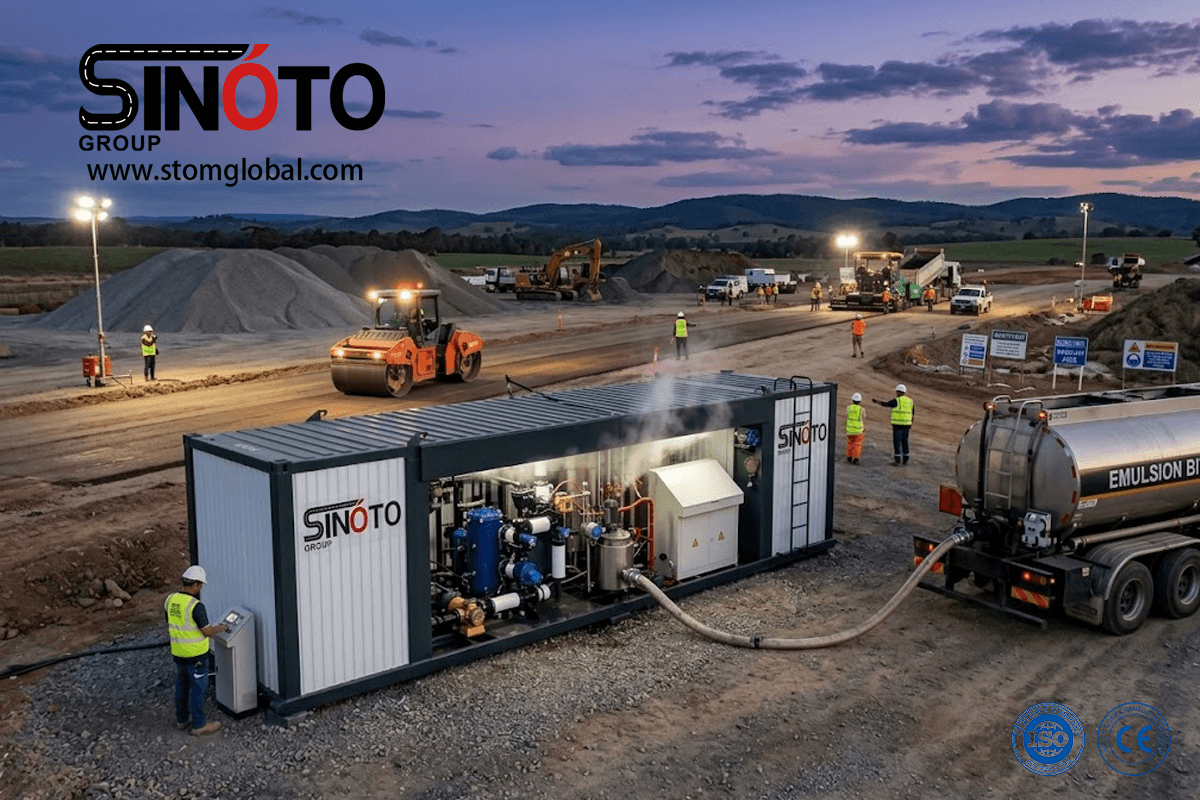
This is one of the most important questions when evaluating an asphalt emulsion machine for sale.
The SINOTO product page confirms that the plant uses Siemens PLC control technology for precise proportioning of asphalt, emulsion, and water. It also states that automatic compensation controls the proportioning error within approximately 0.5%. Asphalt and emulsion pipelines use pneumatic valves to reduce manual intervention.
Therefore, the plant is designed for automated coordinated material proportioning rather than requiring operators to manually adjust the asphalt and emulsion flows throughout normal production.
However, the exact pump synchronization logic should be confirmed against the customer’s specific formulation and selected model.
Bitumen Tank
↓
Bitumen Heating
↓
Bitumen Pump + Metering
↘
PLC Control
↗
Soap Preparation
↓
Soap/Emulsion Pump + Metering
↓
High-Shear Colloid Mill
↓
Emulsion Pumping & Cooling
↓
Emulsion Storage
The PLC acts as the central control system.
The goal is to keep the required material relationship stable as production proceeds.
🤖 Automation Advantage: The value of PLC automation is not simply that the machine starts and stops automatically. It helps coordinate material proportioning, valves, pumping and process parameters so operators do not need to constantly perform manual dosing adjustments.
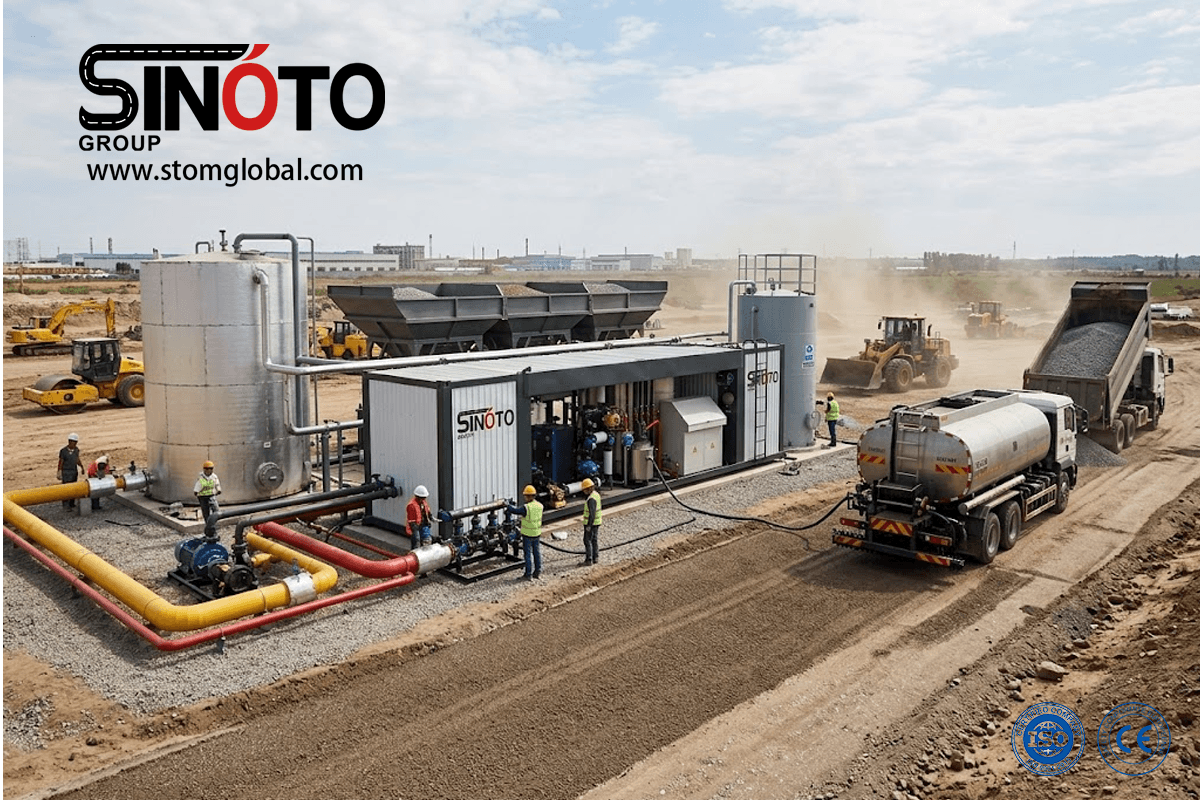
The final properties of asphalt emulsion depend strongly on formulation.
If the amount of bitumen changes significantly relative to the aqueous soap phase, the final product can behave differently in terms of viscosity, stability, breaking characteristics, and application performance.
This is particularly important for producers supplying multiple asphalt emulsion grades.
For example, one customer may require a rapid-setting cationic emulsion while another requires a slow-setting product.
The equipment therefore needs to accommodate formulation changes while maintaining accurate material proportioning.
| Control Function | Purpose |
|---|---|
| Bitumen proportioning | Controls asphalt feed |
| Water proportioning | Controls aqueous phase |
| Emulsion/soap proportioning | Maintains formulation |
| Automatic compensation | Corrects proportioning deviations |
| Pneumatic valves | Reduces manual valve operation |
| Temperature control | Maintains process conditions |
| Tank switching | Supports continuous production |
| Pump coordination | Supports stable material flow |
SINOTO states that the automatic control system uses Siemens PLC technology and automatic compensation, with a stated error control within 0.5%.
This can be particularly valuable for commercial producers where consistent formulation is more important than simply achieving maximum hourly output.
The standard SINOTO configuration uses two soap tanks.
For example, the STEB-10 model uses 2 × 2.15 m³ soap tanks, while the STEB-15 uses 2 × 3 m³ soap tanks.
The product page also states that two emulsion tanks are used alternately to achieve continuous production.
This arrangement provides an important operational advantage.
Tank A
→ Soap preparation / supply
Tank B
→ Ready / supply
↓
Automatic Switching
↓
Tank B
→ Soap preparation / supply
Tank A
→ Ready / supply
This helps prevent the production line from having to stop every time one preparation tank is emptied or needs to be replenished.
For buyers looking for an asphalt emulsion plant for sale, this can be especially relevant when the plant is expected to operate for long production periods.
When comparing a bitumen emulsion plant manufacturer, buyers often begin with bitumen emulsion plant price.
Price is important, but automation and formulation accuracy can have a major effect on long-term operating performance.
A complete comparison should include at least the following.
Ask:
Which PLC is used?
SINOTO specifies Siemens PLC technology.
Then ask:
What parameters are automatically controlled?
The manufacturer states that the system controls asphalt, emulsion and water proportioning and provides automatic compensation.
Do not simply ask:
“Is it automatic?”
Ask:
“What is the stated proportioning error?”
SINOTO specifies automatic compensation with error control within approximately 0.5%.
Pump size varies according to plant capacity.
| Plant | Capacity | Bitumen Pump | Emulsion Pump |
|---|---|---|---|
| STEB-4 | 3–4 TPH | 2.5 m³/h | 4 m³/h |
| STEB-6 | 5–6 TPH | 3.5 m³/h | 8 m³/h |
| STEB-10 | 8–10 TPH | 4.2 m³/h | 12 m³/h |
| STEB-15 | 12–15 TPH | 11.7 m³/h | 20 m³/h |
These are published equipment specifications, so buyers can use them when comparing different bitumen emulsion machine price quotations.
SINOTO states that its emulsifier dilution, emulsion blending, and conveying systems use corrosion-resistant 316 stainless steel or PPR materials and are suitable for strong acid and strong alkali environments.
This can be an important consideration when the formulation requires acid, alkali, or aggressive chemical additives.
A quotation should clarify whether the following are included:
PLC cabinet
Automatic proportioning
Pump control
Pneumatic valves
Temperature control
Tank switching
Alarm system
Emergency stop
Manual override
Production monitoring
This helps buyers compare an asphalt emulsion plant price on a like-for-like basis.
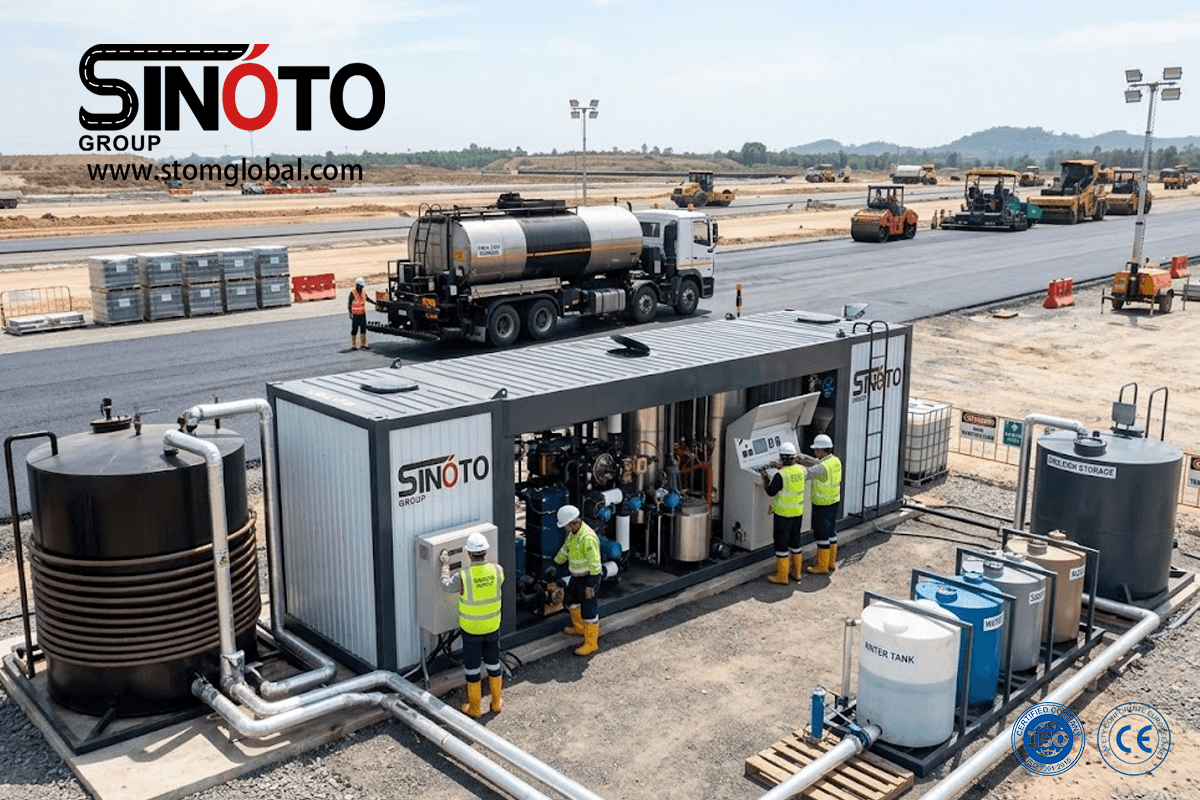
If you are searching for a bitumen emulsion plant for sale, the more detailed your technical requirement is, the more accurate the quotation can be.
Instead of sending:
“Please quote a 10 TPH asphalt emulsion plant.”
provide a more complete requirement.
Required capacity: 6 / 10 / 15 TPH
Bitumen solid content: ______ %
Emulsion type: CRS / CSS / CQS / other
Bitumen grade: ______
Emulsifier: ______
Acid / alkali: ______
Polymer/additive: ______
Required automation: Manual / Automatic
Power supply: ______ V / Hz
Destination country: ______
Storage capacity: ______ m³
Required working hours: ______ hours/day
This information allows the bitumen emulsion machine manufacturer to determine the appropriate tank sizes, pump capacities, heating system, colloid mill, metering system, and control configuration.
For a commercial asphalt emulsion producer, automated proportioning can provide several practical advantages.
Automatic proportioning reduces dependence on manual measurement.
Pneumatic valves and PLC control reduce repetitive manual operation.
The same formulation can be reproduced more consistently between production runs.
Alternating tanks help maintain material availability during longer production periods.
The manufacturer states that automatic compensation can keep proportioning error within approximately 0.5%.
Operators can focus more on monitoring the production process instead of continuously adjusting individual valves.
🚀 Buyer Takeaway: For a modern asphalt emulsion machine, automation should be evaluated as a complete control architecture—not simply as an “automatic” label. PLC proportioning, pump control, pneumatic valves, tank switching, temperature management and manual override functions should all be included in the technical quotation.
The direct answer is:
The SINOTO Emulsion Bitumen Plant uses dedicated water and soap systems to prepare the aqueous phase, with the exact emulsifier and acid/alkali formulation determined by the target asphalt emulsion. The plant uses Siemens PLC control for precise proportioning of asphalt, emulsion and water, with automatic compensation and a stated proportioning error control within approximately 0.5%. Asphalt and emulsion pipelines use pneumatic valves to reduce manual intervention.
The standard models also have dedicated bitumen and emulsion pumps with different capacities according to production output.
| Buyer Question | SINOTO Product Information |
|---|---|
| How is soap prepared? | Dedicated water and soap preparation system |
| Is emulsifier included? | Yes, system supports different emulsifiers |
| Can acid/alkali be used? | System materials are specified as resistant to strong acid/alkali; exact dosing depends on formulation |
| Is metering automated? | Yes, automatic PLC proportioning is available |
| PLC technology | Siemens PLC |
| Stated proportioning error | Within approximately 0.5% with automatic compensation |
| Are valves automated? | Pneumatic valves are used on asphalt/emulsion pipelines |
| Are asphalt and emulsion flows coordinated? | PLC-based automatic proportioning supports coordinated material control |
| Are pumps model-specific? | Yes |
| Continuous production? | Two emulsion tanks operate alternately |
| Manual operation available? | Yes; control system ranges from manual to manual/automatic by model |
The key point for buyers is that the plant is designed as an integrated metering and emulsification system, rather than simply a colloid mill connected to separate pumps.
When comparing a bitumen emulsion plant price, buyers should therefore evaluate the complete automation package, including PLC control, dosing, pumps, pneumatic valves, tank configuration, heating, cooling and emulsification.
If you are looking for a bitumen emulsion plant for sale, bitumen emulsion machine for sale, or complete asphalt emulsion plant for sale, provide SINOTO with your target capacity and formulation requirements.
For a faster technical proposal, include your:
Target capacity + bitumen content + emulsion grade + emulsifier + acid/alkali + automation requirement + destination country.
The engineering team can then recommend the appropriate soap tanks, pumps, metering system, colloid mill, heating/cooling equipment and PLC control configuration.
👉 REQUEST A QUOTE FOR YOUR BITUMEN EMULSION PLANT

Whatsapp ID: 8619059581045

WeChat ID: +8619059581045