When buyers compare a bitumen emulsion plant, one of the most important technical questions is not simply how many tons per hour the equipment can produce. The real question is: how effectively can the plant break hot bitumen into fine, uniform droplets and maintain a stable asphalt emulsion?
For road contractors, asphalt producers, pavement maintenance companies, and infrastructure developers, the colloid mill is the core component responsible for the high-shear emulsification process. Its design, rotor-stator clearance, power, wear resistance, and operating conditions directly influence the quality of the final emulsion.
The SINOTO Emulsion Bitumen Plant uses a high-precision, high-shear colloid mill as its core emulsification technology. According to the product information, the rotor and stator are made from wear-resistant and corrosion-resistant special alloy materials, while the clearance between them can be adjusted to the micron level, with adjustment down to 0.01 mm.
Related SINOTO technical information states that the high-shear colloid mill can produce typical bitumen droplets in the range of approximately 2–5 microns, while other company technical material describes a uniform droplet size of less than 5 microns.
💡 Quick Answer: The core mill technology is a high-shear, high-precision colloid mill, rather than a conventional low-shear mixer. The rotor-stator gap can be adjusted down to 0.01 mm, and the typical bitumen droplet size is approximately 2–5 microns under suitable operating conditions.
A modern asphalt emulsion plant needs to transform hot bitumen into extremely small droplets and disperse them throughout an aqueous phase containing water and emulsifiers.
Bitumen and water do not naturally mix. Without sufficient mechanical shear and an appropriate emulsifier system, the bitumen droplets can combine again, causing separation or instability.
This is why the colloid mill is much more than an ordinary mixing device.
The basic process can be represented as:
Hot Bitumen + Water + Emulsifier
↓
High-Speed Rotor-Stator Shearing
↓
Bitumen Broken Into Fine Droplets
↓
Uniform Dispersion in Water
↓
Stable Asphalt Emulsion
The rotor rotates at high speed inside the stator. As the bitumen-water mixture passes through the narrow rotor-stator gap, intense mechanical shear breaks the bitumen into much smaller droplets.
The smaller and more uniform the droplets are, the more effectively the emulsifier can surround and stabilize them.
This is particularly important for asphalt emulsion production, because final emulsion performance depends on more than simply achieving a high production rate.
| Parameter | SINOTO Emulsion Bitumen Plant |
|---|---|
| Core technology | High-shear colloid mill |
| Mill configuration | Rotor + stator |
| Rotor-stator clearance | Adjustable down to 0.01 mm |
| Typical bitumen droplet size | Approx. 2–5 microns |
| Main function | High-speed mechanical emulsification |
| Rotor/stator material | Wear-resistant and corrosion-resistant alloy |
| Suitable emulsions | Cationic, anionic and modified emulsions |
| PLC dosing accuracy | Up to approximately ±0.5% according to product information |
| Production range | 3–20 TPH |
The standard plant range includes STEB-4, STEB-6, STEB-10 and STEB-15, with capacities from approximately 3–4 TPH to 12–15 TPH. The product page lists overall productive capacity of 3–20 TPH, with customized solutions available.
📌 Buyer Focus: When comparing an asphalt emulsion plant manufacturer, do not compare only TPH. Ask about the colloid mill type, rotor-stator clearance, mill power, expected droplet size, material of construction, and ability to maintain consistent emulsification.
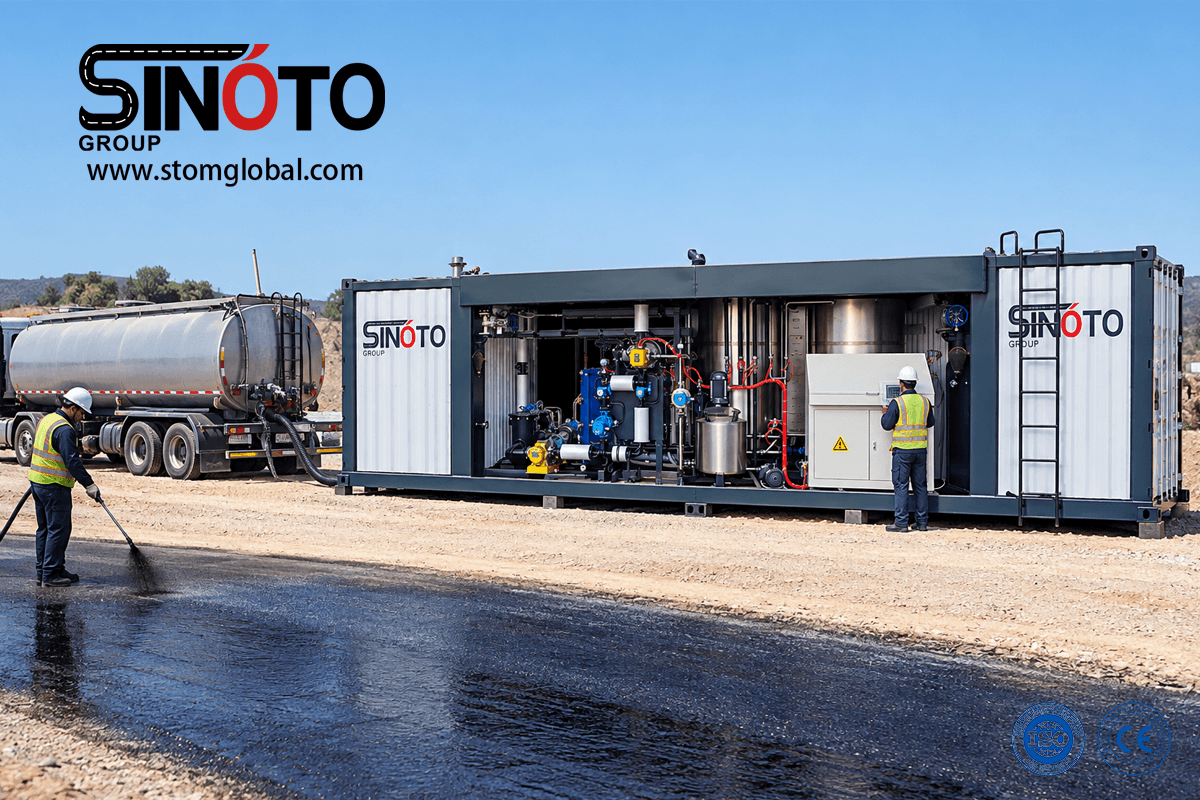
For buyers researching an asphalt emulsion plant, particle size is one of the most important technical specifications because it affects dispersion, storage stability, viscosity, and the breaking behavior of the finished emulsion.
SINOTO’s technical information indicates that its high-shear colloid mill can achieve bitumen droplet sizes of approximately 2–5 microns. Another SINOTO technical article describes uniform droplet size below 5 microns.
It is important to understand that this is a typical technical range rather than a guarantee that every formulation will always produce exactly the same particle-size distribution.
Actual results can vary depending on:
Bitumen grade
Bitumen temperature
Water temperature
Emulsifier type
Emulsifier concentration
Bitumen-to-water ratio
Rotor-stator clearance
Colloid mill operating conditions
Pumping rate
Required emulsion grade
Polymer or additive formulation
Consider the difference between a large, uneven droplet distribution and a fine, relatively uniform distribution.
Larger / less uniform droplets
→ Greater tendency toward instability
→ Less consistent dispersion
→ Potential storage problems
→ Less predictable breaking behavior
Fine / uniform droplets
→ Better dispersion
→ More stable emulsion structure
→ More consistent application
→ Better control of final emulsion characteristics
The goal of an Emulsion Bitumen Plant is therefore not simply to make the particles as small as possible. The real objective is to create a controlled and appropriate particle-size distribution for the required asphalt emulsion formulation.
| Emulsification Stage | Approximate Condition |
|---|---|
| Heated bitumen feed | Continuous liquid phase |
| Initial mixing | Bitumen dispersed into water |
| High-shear zone | Intensive rotor-stator shearing |
| Fine emulsion | Approx. 2–5 μm typical droplet range |
| Final product | Stabilized asphalt emulsion |
This distinction is important when evaluating a bitumen emulsion plant for sale. A supplier should be able to explain not only the advertised particle size but also the process conditions used to achieve it.
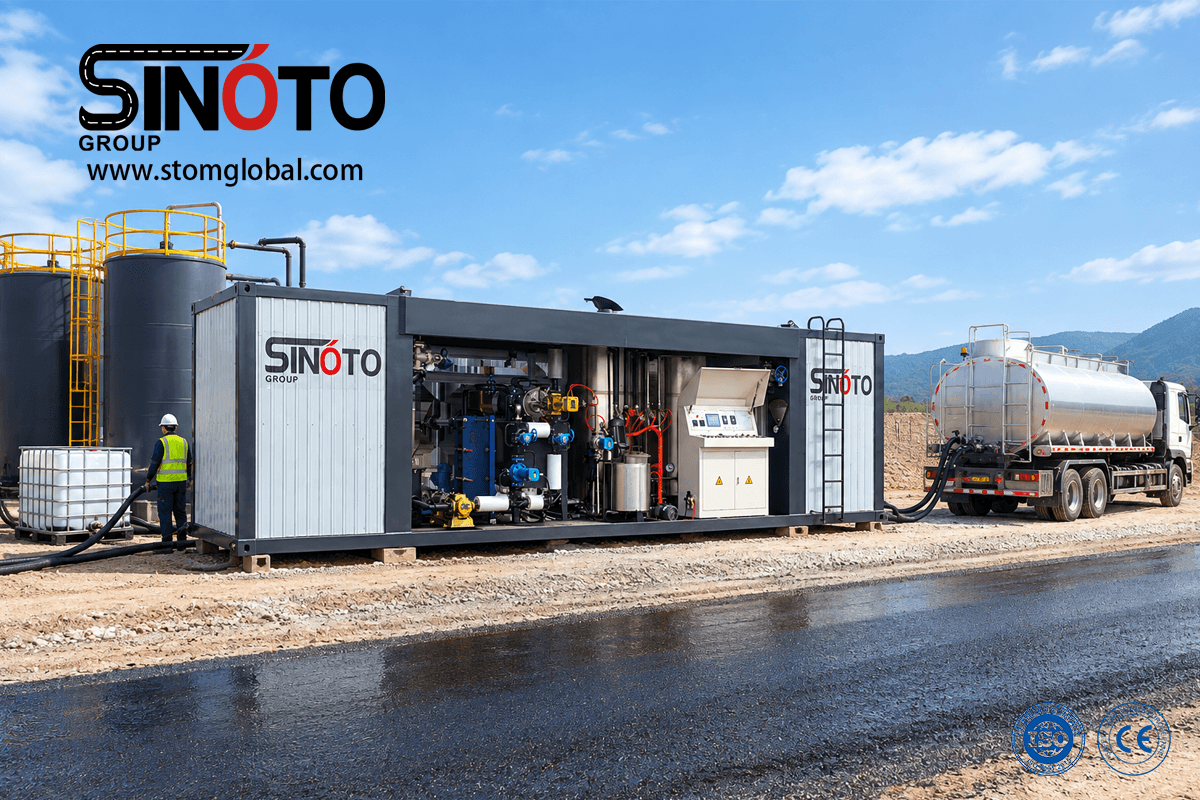
A high-performance colloid mill contributes to the overall asphalt emulsion production process in several ways.
The main advantage is the intense shear generated between the rotor and stator.
Instead of relying on slow mechanical agitation, the colloid mill subjects the bitumen-water mixture to a high-energy shearing environment.
This rapidly reduces the size of dispersed bitumen droplets.
The SINOTO system allows the rotor-stator clearance to be adjusted to the micron level, with the product page specifying adjustment down to 0.01 mm.
This gives the operator greater control over the emulsification process.
A narrow clearance increases the intensity of mechanical interaction, while the appropriate operating gap depends on the material formulation and production requirements.
For buyers, adjustable clearance is therefore an important specification to ask about when comparing a bitumen emulsion plant price.
SINOTO specifies special alloy materials for the stator and rotor, designed for wear resistance and corrosion resistance. The manufacturer states that the service life can be approximately three times that of ordinary mills under its stated comparison.
This is particularly relevant for commercial producers.
The colloid mill is a high-energy component operating continuously under demanding conditions. Wear of the rotor and stator can affect the operating gap and therefore the emulsification process.
A durable mill can help reduce maintenance frequency and maintain consistent production.
The plant is designed to work with different emulsifiers and additives.
The product page lists RS, CRS, MS, CMS, SS, and CSS/CQS emulsion bitumen types, and describes suitability for anionic, cationic, fast-setting, medium-setting, slow-setting, and modified emulsion bitumen.
This makes the system relevant to buyers looking for a cationic emulsion plant as well as producers who need multiple asphalt emulsion formulations.
For customers producing higher-performance emulsions, the manufacturer states that the equipment can be configured for SBS and SBR modified bitumen emulsion production, using heavy-duty mills and enhanced soap systems.
This can be relevant for road applications where improved performance characteristics are required.
However, buyers should provide the exact polymer type and target formulation when requesting a quotation because the required configuration can change according to the formulation.
🧠 Expert Tip: Do not assume that every asphalt emulsion has the same particle-size requirement. The target droplet distribution should be matched to the emulsion formulation, emulsifier chemistry, bitumen grade, and intended road application.
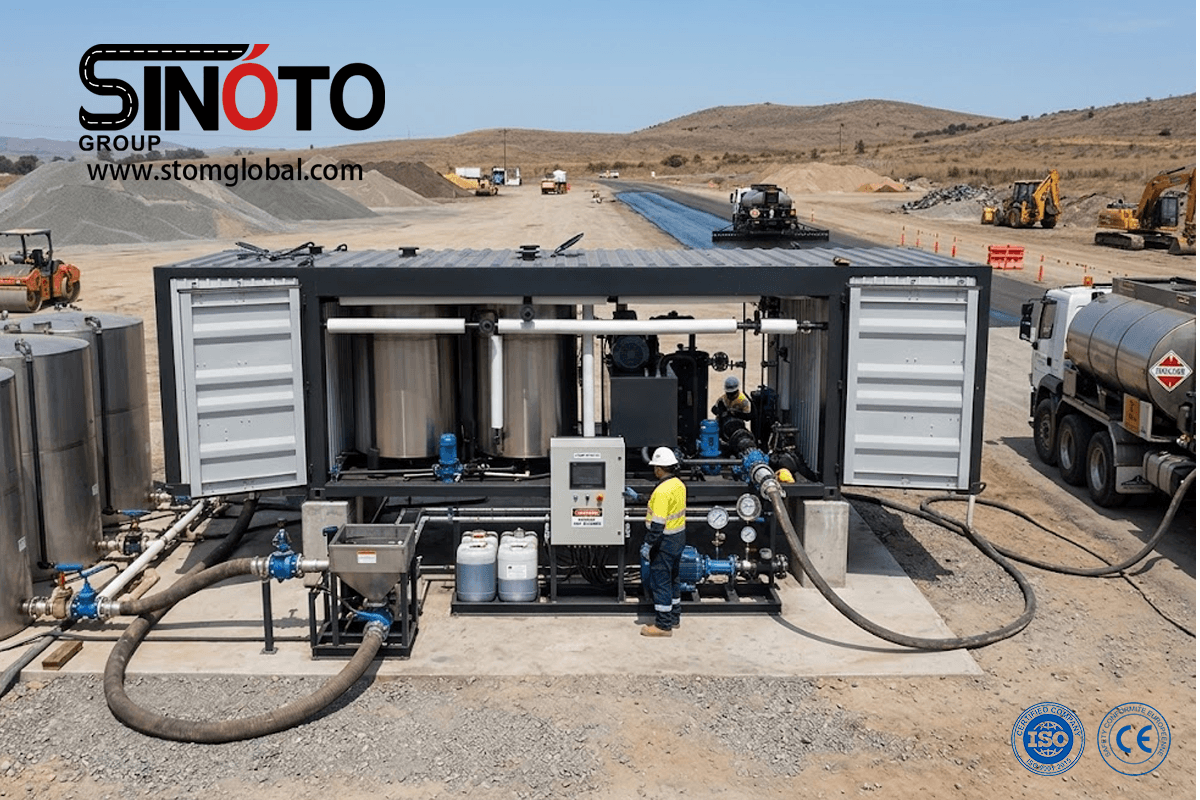
When purchasing an Emulsion Bitumen Plant, many buyers initially focus on asphalt emulsion plant price. Price is important, but the colloid mill and complete emulsification system deserve equal attention.
A lower initial equipment price can become less attractive if the plant requires frequent mill maintenance, produces inconsistent emulsion, or lacks the flexibility needed for different formulations.
Ask the manufacturer:
Is the mill high-shear?
For a modern bitumen emulsion plant, a high-shear colloid mill is the key technology used to generate fine droplets.
Ask: What is the minimum adjustable clearance?
SINOTO specifies adjustment down to 0.01 mm.
This is a useful technical benchmark when comparing equipment suppliers.
Ask: What bitumen droplet size can the plant typically achieve?
SINOTO technical information gives approximately 2–5 microns as a typical range, with other technical material describing droplets below 5 microns.
However, buyers should request the particle-size distribution for their specific formulation if particle size is a critical project specification.
The standard SINOTO models use different colloid mill motor powers:
| Model | Production Capacity | Colloid Mill Power |
|---|---|---|
| STEB-4 | 3–4 TPH | 11 kW |
| STEB-6 | 5–6 TPH | 22 kW |
| STEB-10 | 8–10 TPH | 37 kW |
| STEB-15 | 12–15 TPH | 45 kW |
These specifications are published on the product page.
For example, buyers searching for a 6 tph asphalt emulsion plant can consider the STEB-6 class, while customers searching for a 10 tph bitumen emulsion plant can consider the STEB-10 class.
The colloid mill cannot operate independently.
A complete asphalt emulsion plant also needs:
Bitumen heating system
Bitumen metering system
Water heating system
Soap preparation tanks
Emulsifier dosing system
Bitumen pump
Emulsion pump
Heat exchanger
Cooling system
Control system
Storage and transfer system
The SINOTO product page lists these components as part of the overall plant configuration.
This is why the right purchasing question is not simply:
“How powerful is the colloid mill?”
A better question is:
“How does the entire production system work together to achieve the required emulsion quality?”
A major buyer concern is flexibility.
A contractor may initially need a 6 tph asphalt emulsion plant, but future projects may require a higher output. Another producer may need a 10 tph bitumen emulsion plant with automated dosing and multiple emulsion formulations.
SINOTO provides several standard capacity classes and customized configurations.
STEB-4
3–4 TPH
11 kW colloid mill
STEB-6
5–6 TPH
22 kW colloid mill
STEB-10
8–10 TPH
37 kW colloid mill
STEB-15
12–15 TPH
45 kW colloid mill
The manufacturer also describes customized continuous production lines for large infrastructure projects.
The plant uses Siemens PLC control technology for precise proportioning of asphalt, emulsifier, and water. The product information states that its automatic compensation function can control proportioning error within approximately 0.5%.
This is important because particle size alone does not determine emulsion quality.
The ratio between bitumen, water, emulsifier, and additives must also remain consistent.
The plant uses two emulsion tanks alternately. According to the product information, this arrangement supports continuous production and reduces the need for manual intervention.
For commercial asphalt emulsion production, this can help maintain a steady material flow and improve overall production efficiency.
For international buyers, logistics can be another major consideration.
The SINOTO system uses an integrated skid-mounted and modular configuration designed for container transportation. The manufacturer states that the production line can fit into standard 40-foot high-cube containers.
This can simplify international transportation and overseas installation.
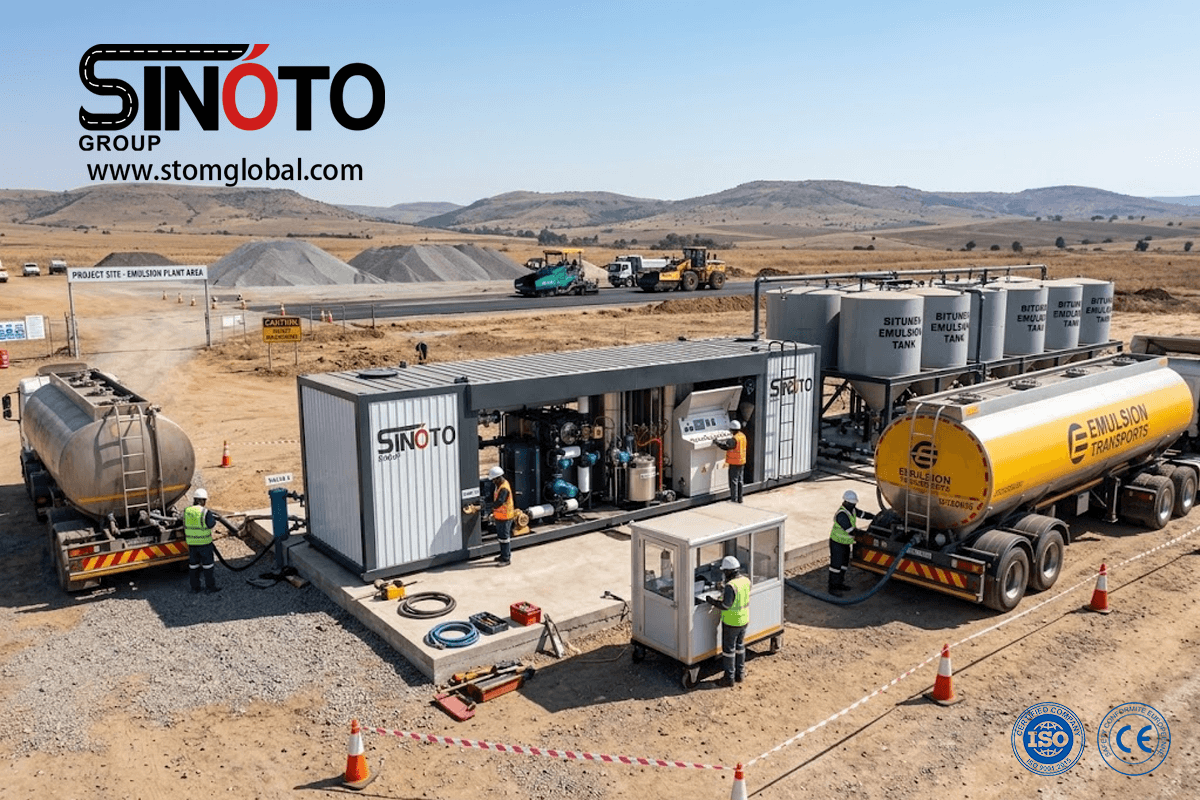
For buyers comparing an Emulsion Bitumen Plant, the core technology can be summarized clearly:
Core colloid mill type:
High-precision high-shear colloid mill using a rotor-stator system.
Minimum rotor-stator clearance:
Adjustable down to approximately 0.01 mm.
Typical bitumen droplet size:
Approximately 2–5 microns, with related SINOTO technical material also describing a uniform droplet size below 5 microns.
Main benefit:
High-speed mechanical shearing creates fine and relatively uniform bitumen droplets, supporting stable asphalt emulsion production.
Compatible products:
Cationic, anionic, rapid-setting, medium-setting, slow-setting and modified asphalt emulsions, depending on the configuration and formulation.
🚧 Buyer Takeaway: If you are evaluating a bitumen emulsion plant for sale, don’t compare suppliers only by production capacity or bitumen emulsion plant price. The colloid mill’s shear technology, rotor-stator clearance, expected droplet size, wear resistance, dosing accuracy and formulation flexibility are all important purchasing criteria.
For a buyer searching for an asphalt emulsion plant manufacturer, these technical specifications provide a more meaningful basis for comparing suppliers.
Whether your requirement is a 6 tph asphalt emulsion plant, a 10 tph bitumen emulsion plant, or a larger customized system, the colloid mill should be evaluated as the core component of the complete production line.
Tell SINOTO your required production capacity, bitumen grade, emulsion type, target particle size, working voltage, destination country, and intended road application.
The engineering team can then recommend the appropriate colloid mill power, rotor-stator configuration, tank system, dosing system, and overall asphalt emulsion plant configuration.
👉 Request a Quote for an Emulsion Bitumen Plant
WhatsApp: +86 190 5958 1045
Email: info@stomglobal.com
Website: www.stomglobal.com
#EmulsionBitumenPlant #BitumenEmulsionPlant #AsphaltEmulsionPlant #AsphaltEmulsion #ColloidMill #RoadConstruction

Whatsapp ID: 8619059581045

WeChat ID: +8619059581045

