What is the maximum bitumen content that a bitumen emulsion plant can handle? For buyers comparing asphalt emulsion production systems, this is an important technical question because the bitumen-to-water ratio directly affects the final emulsion formulation, viscosity, storage behavior, application performance, and production requirements.
According to the SINOTO product specifications, the maximum listed bitumen solid content is ≤68%. This means the plant is designed to produce emulsified asphalt formulations with bitumen solid content up to approximately 68%, subject to the specific formulation, emulsifier system, raw materials, and operating conditions.
The plant has a stated productive capacity range of 3–20 TPH, with standard models including STEB-4, STEB-6, STEB-10, and STEB-15. The system uses a high-precision colloid mill, automatic material proportioning, heating, emulsification, pumping, cooling, and control systems to produce different asphalt emulsion formulations.
💡 Quick Answer: The SINOTO bitumen emulsion plant specifies a maximum bitumen solid content of ≤68%. The actual operating percentage for a particular emulsion should be determined according to the required product grade, emulsifier chemistry, bitumen type, polymer or additive content, and local technical standards.
For buyers, the important point is that 68% is a stated technical upper limit, not a universal target for every asphalt emulsion product.
An asphalt emulsion plant produces an oil-in-water dispersion by mechanically breaking heated bitumen into small droplets and dispersing those droplets throughout an aqueous phase containing water and emulsifiers.
The basic formulation can be simplified as:
Bitumen + Water + Emulsifier + Additives
↓
High-Shear Emulsification
↓
Fine Bitumen Droplets
↓
Stable Asphalt Emulsion
The percentage of bitumen determines how much of the final emulsion consists of the asphalt phase.
For example, an emulsion with approximately 60% bitumen contains a substantially different ratio of water and asphalt phase than an emulsion formulated near the plant’s stated 68% solid-content limit.
This is why buyers should not evaluate a bitumen emulsion machine only by its production capacity.
| Parameter | SINOTO Specification / Consideration |
|---|---|
| Maximum listed bitumen solid content | ≤68% |
| Overall productive capacity | 3–20 TPH |
| Standard model range | 3–4, 5–6, 8–10, 12–15 TPH |
| Core emulsification technology | High-precision colloid mill |
| Rotor-stator clearance | Adjustable down to 0.01 mm |
| Emulsion types | RS / CRS / MS / CMS / SS / CSS / CQS |
| Control options | Manual / Automatic |
| Modified emulsion capability | SBS / SBR configuration available |
| Material compatibility | Cationic, anionic, fast-, medium-, slow-setting and modified emulsions |
The manufacturer states that different emulsifiers and additives can be used to manufacture emulsified bitumen with different technical parameters.
Therefore, the maximum bitumen content should always be considered together with the required final product specification.
The formulation affects several characteristics of the final emulsion:
Viscosity
Storage stability
Breaking behavior
Pumpability
Aggregate coating
Application performance
Water separation behavior
Required emulsifier dosage
A producer making a standard road emulsion may use a different formulation from a producer making a specialized modified emulsion.
The bitumen emulsion equipment therefore needs sufficient control over bitumen metering, water metering, emulsifier dosing, temperature, and emulsification intensity.
📌 Buyer Insight: Do not ask only, “Can the plant produce 68% bitumen content?” A better question is, “Can the proposed configuration consistently produce my required bitumen content and emulsion grade at my target production rate?”
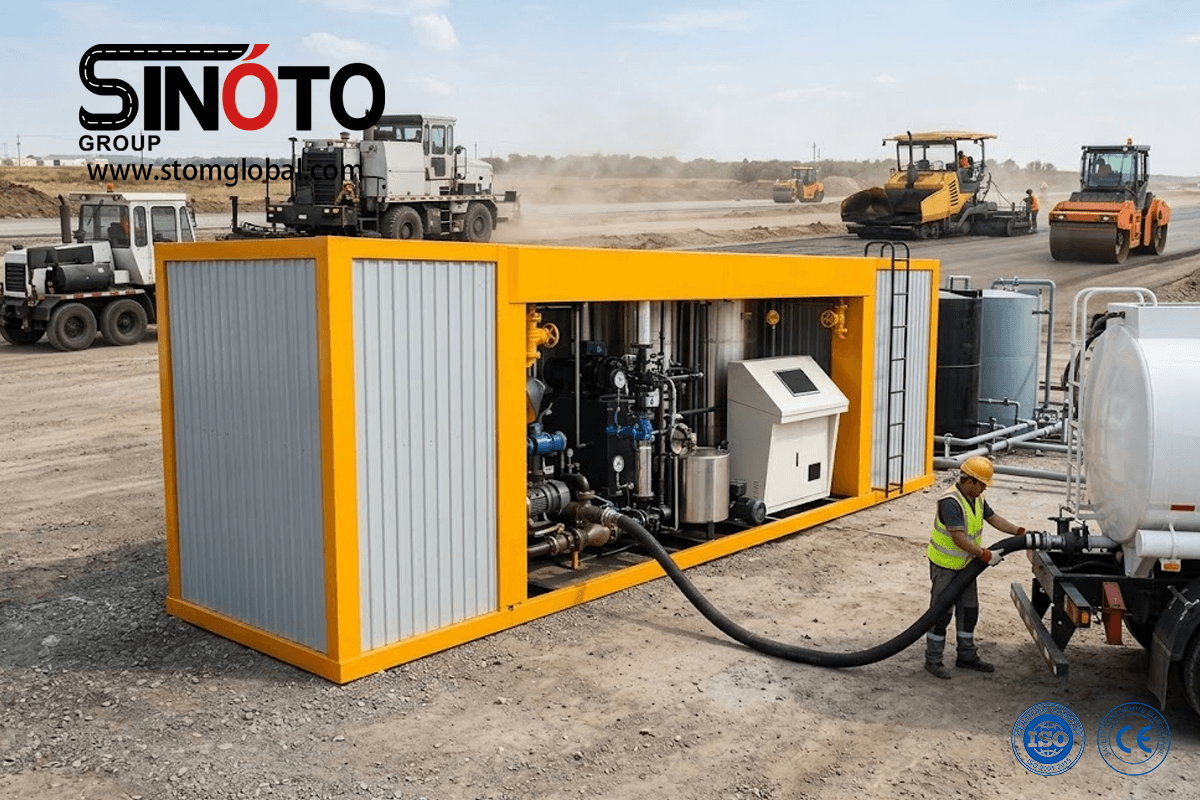
Yes. The published specification of the SINOTO bitumen emulsion machine lists bitumen solid content at ≤68%.
However, achieving a specific high-solids formulation is not determined by the colloid mill alone.
A complete production system must coordinate several parameters.
When the target bitumen content is high, accurate material proportioning becomes particularly important.
For example, the difference between a 60% formulation and a formulation approaching the 68% upper limit represents a meaningful change in the relative proportions of asphalt and aqueous phases.
The SINOTO system uses PLC control technology for precise proportioning of asphalt, emulsion, and water. The manufacturer states that its automatic compensation function can control proportioning error within approximately 0.5%.
This is particularly relevant for an asphalt emulsion plant manufacturer serving customers who require repeatable formulations.
Water is not simply a filler in asphalt emulsion.
The aqueous phase contains emulsifiers and other additives that help stabilize the bitumen droplets.
The plant therefore includes dedicated water and soap preparation systems.
Depending on the selected model, the equipment uses different water-tank and soap-tank capacities.
The colloid mill is responsible for applying intense mechanical shear to the bitumen-water mixture.
The SINOTO product page specifies a high-precision colloid mill with rotor-stator clearance adjustable down to approximately 0.01 mm.
This high-shear process helps create fine and relatively uniform bitumen droplets.
Bitumen must be heated to an appropriate processing temperature before emulsification.
At the same time, the finished emulsion needs controlled cooling.
SINOTO uses a heat-exchange and cooling system designed to reduce emulsion temperature rapidly after emulsification.
For high-solids emulsions, proper temperature management is especially important because viscosity and flow behavior can change significantly with temperature.
A high-solids emulsion can place different demands on pumps and pipelines compared with a lower-solids formulation.
The plant therefore integrates:
Bitumen pumps
Emulsion pumps
Metering systems
Insulated pipelines
Pneumatic valves
Cooling systems
The appropriate pump capacity depends on the selected plant model and required production rate.
The maximum plant capability and the normal formulation of a particular emulsion are two different questions.
The SINOTO product page lists several emulsion categories, including RS, CRS, MS, CMS, SS, CSS, and CQS.
Different products can use different bitumen contents depending on their formulation and applicable standards.
The following table should be viewed as a technical reference rather than a universal formulation specification. The final formulation should be confirmed according to the customer’s required emulsion grade and applicable standard.
| Emulsion / Product Type | Example Bitumen Content | Key Consideration |
|---|---|---|
| General asphalt emulsion | Formulation dependent | Balance stability and application performance |
| Cationic emulsion | Formulation dependent | Emulsifier chemistry and aggregate compatibility |
| Anionic emulsion | Formulation dependent | Water phase and emulsifier system |
| Slow-setting emulsion | Formulation dependent | Controlled breaking behavior |
| Rapid-setting emulsion | Formulation dependent | Faster breaking and aggregate coating |
| Modified emulsion | Formulation dependent | Polymer type and concentration |
| SINOTO plant maximum listed content | ≤68% | Confirm exact formulation before production |
This distinction is important for anyone comparing bitumen emulsion plant price.
A supplier may advertise a high maximum solids content, but the buyer still needs to determine whether the plant can produce the specific emulsion grade required for the project.
A formulation near 68% represents a high proportion of asphalt solids in the final emulsion.
At this level, the production system needs to maintain appropriate:
Bitumen Flow
→ Water/Soap Flow
→ Temperature
→ High-Shear Mixing
→ Droplet Distribution
→ Cooling
→ Storage Stability
The manufacturer therefore needs to know the buyer’s target formulation before confirming the final configuration.
⚠️ Important: “≤68%” should be read as the plant’s published maximum bitumen solid-content specification. It does not mean that every CRS, CSS, CQS, or polymer-modified emulsion should be produced at 68%.
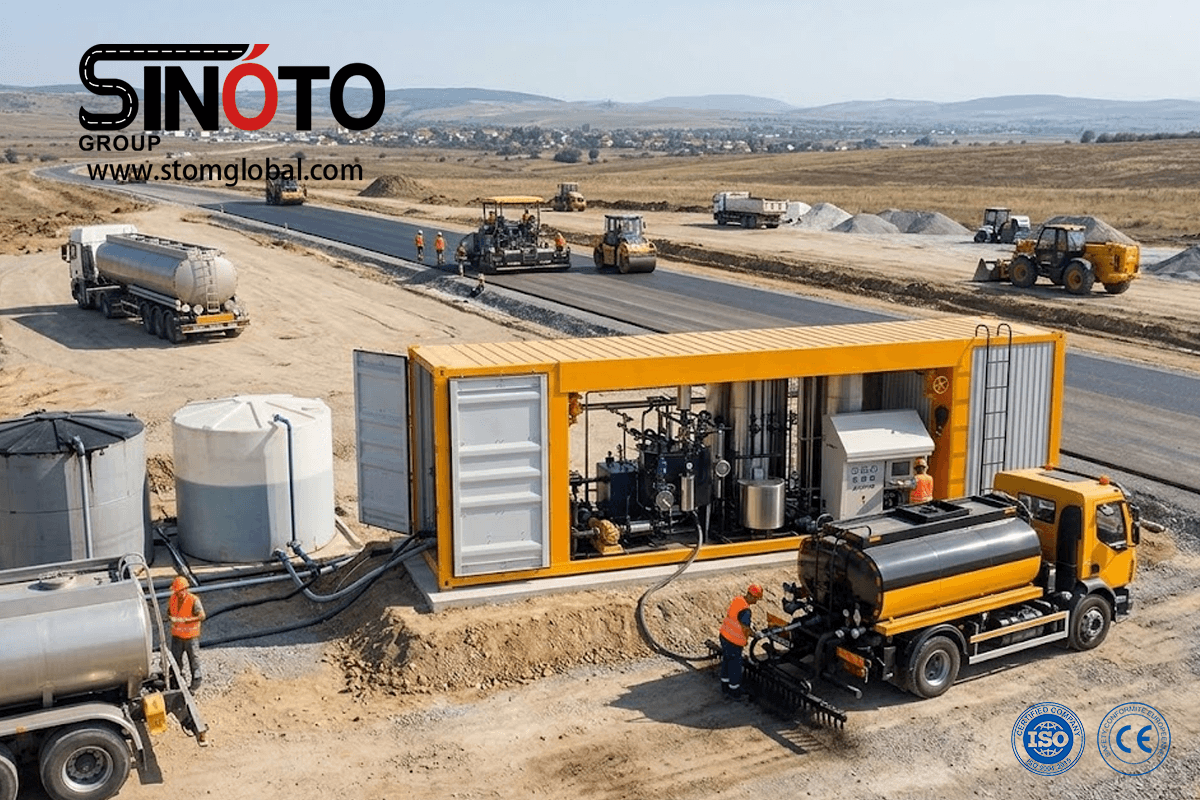
For customers searching for bitumen emulsion equipment, production capacity and maximum bitumen content are two important specifications—but they are not the only ones.
A professional purchasing comparison should examine the complete production line.
The SINOTO specification is:
≤68% bitumen solid content
Ask the manufacturer to confirm the target content for your specific formulation.
The standard models include:
| Model | Capacity | Colloid Mill Power |
|---|---|---|
| STEB-4 | 3–4 TPH | 11 kW |
| STEB-6 | 5–6 TPH | 22 kW |
| STEB-10 | 8–10 TPH | 37 kW |
| STEB-15 | 12–15 TPH | 45 kW |
The product page gives an overall productive-capacity range of 3–20 TPH, with customized production solutions available.
For a buyer looking for a 10 tph bitumen emulsion plant, the STEB-10 is listed at 8–10 TPH.
Ask about:
Mill type
Motor power
Rotor material
Stator material
Rotor-stator clearance
Wear resistance
Maintenance requirements
The SINOTO system uses a high-precision colloid mill, with clearance adjustable down to 0.01 mm.
The product page lists:
RS
CRS
MS
CMS
SS
CSS
CQS
Modified asphalt emulsions
The manufacturer also states that SBS and SBR modified emulsion production can be supported with the appropriate configuration.
The system is available with manual and automatic control configurations.
The automatic version uses PLC technology to manage material proportioning and production parameters.
For commercial producers, automatic control can reduce operator intervention and improve formulation repeatability.
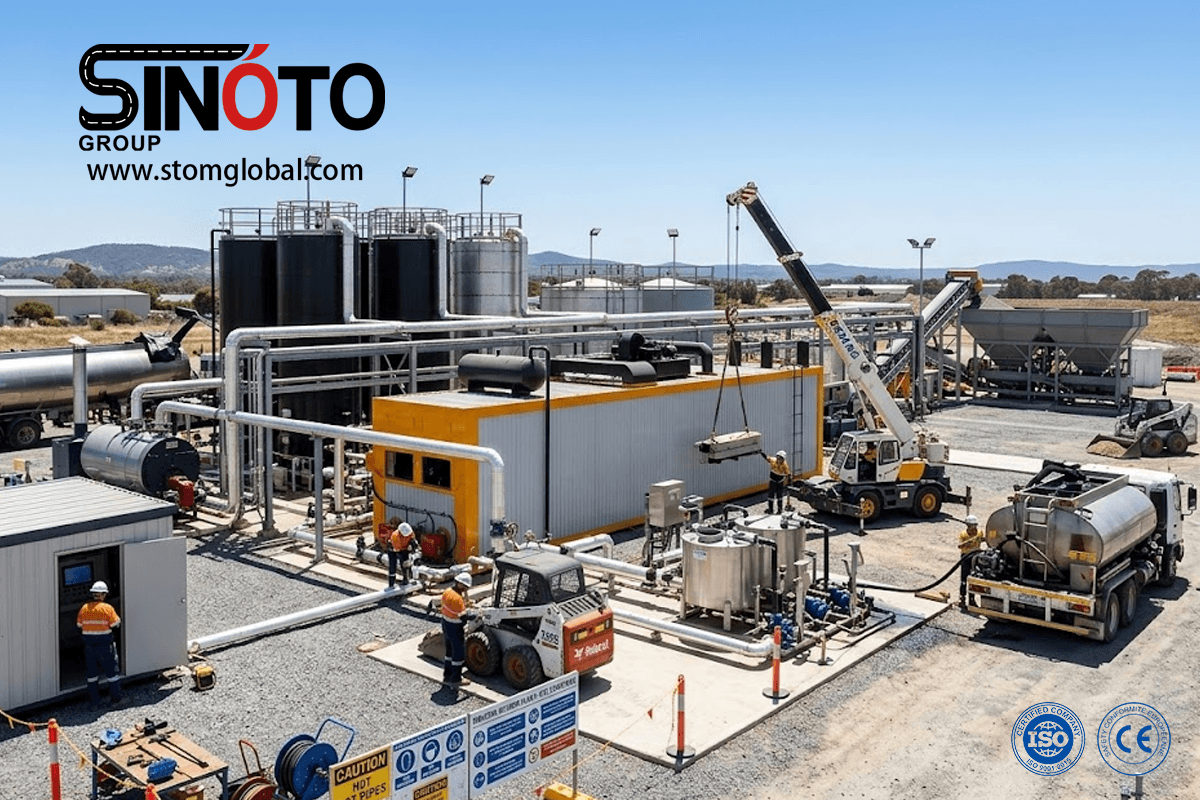
A buyer looking for an asphalt emulsion plant for sale may initially focus on production capacity.
For example:
“I need 10 TPH.”
But a complete technical requirement should be more detailed:
10 TPH + 65% bitumen content + CRS + automatic dosing + specified storage capacity + local electrical standard
This gives the asphalt emulsion plant manufacturer much more information for equipment selection.
The bitumen emulsion plant price depends on the complete system rather than one specification.
Factors can include:
Production capacity
Bitumen content requirement
Colloid mill power
Automation level
Heating system
Cooling system
Pump specifications
Tank capacity
Emulsifier system
Modified-emulsion requirements
Storage configuration
Electrical standard
Spare parts
Shipping requirements
A buyer should therefore avoid comparing two bitumen emulsion machine for sale quotations simply by their headline price.
Instead, compare the complete technical scope.
| Buyer Concern | What to Confirm |
|---|---|
| Bitumen content | Up to ≤68% listed |
| Capacity | 3–20 TPH overall range |
| Required output | 3–4 / 5–6 / 8–10 / 12–15 TPH standard models |
| Emulsion type | CRS / CSS / CQS / others |
| Colloid mill | Power and adjustable clearance |
| Dosing | Manual or PLC automatic |
| Modified emulsion | SBS / SBR configuration |
| Heating | Bitumen and water heating |
| Cooling | Heat exchanger / cooling system |
| Materials | 316 stainless steel or PPR in relevant systems |
| Installation | Modular / containerized design |
This checklist can make supplier comparisons much more transparent.
There is no single bitumen percentage that is automatically best for every application.
The correct content depends on the target product.
A road contractor producing one specific grade may require a different formulation from an asphalt emulsion manufacturer supplying multiple markets.
The correct approach is:
Define Application
↓
Define Emulsion Grade
↓
Define Bitumen Content
↓
Define Emulsifier System
↓
Define Production Capacity
↓
Select Plant Configuration
This approach prevents buyers from purchasing equipment based solely on a maximum specification.
An asphalt emulsion may be used for:
Tack coating
Prime treatment
Chip sealing
Surface dressing
Slurry sealing
Micro-surfacing
Cold-mix asphalt
Pavement preservation
Road maintenance
Specialized modified asphalt applications
Each application can impose different requirements on the emulsion.
For this reason, an experienced bitumen emulsion equipment manufacturer should first understand the customer’s final product before recommending the equipment configuration.
The direct answer is:
The SINOTO Emulsion Bitumen Plant has a published maximum bitumen solid content of ≤68%.
The plant is designed to accommodate different emulsifiers and additives and can produce different types of emulsified bitumen. Its standard capacity range covers 3–20 TPH, while standard models include STEB-4, STEB-6, STEB-10, and STEB-15.
The system combines:
Accurate Metering
High-Shear Colloid Milling
Temperature Control
Emulsifier Preparation
Automated PLC Control
Cooling and Pumping
to support consistent asphalt emulsion production.
🚀 Buyer Takeaway: If your project requires an emulsion with a bitumen content approaching 68%, do not simply request a “68% asphalt emulsion plant.” Provide the manufacturer with your exact bitumen grade, target bitumen percentage, emulsion classification, additives or polymer requirements, production capacity, and destination-country standards. This allows the supplier to verify whether the proposed configuration is suitable.
If you are searching for a bitumen emulsion plant for sale, bitumen emulsion machine, or complete bitumen emulsion equipment, SINOTO can help determine the appropriate configuration for your required bitumen content and production capacity.
When requesting a quotation, provide:
Target bitumen content: ______ %
Required capacity: ______ TPH
Emulsion grade: ______
Bitumen grade: ______
Polymer/additive: ______
Destination country: ______
Power standard: ______
With this information, the asphalt emulsion plant manufacturer can evaluate the appropriate colloid mill, pumps, heating system, dosing system, tanks, cooling system, and control configuration.
👉 REQUEST A QUOTE FOR YOUR BITUMEN EMULSION PLANT

Whatsapp ID: 8619059581045

WeChat ID: +8619059581045

